

In the early hours of St. Andrew’s night (December 13) young people were gathering for celebrating, biting kalyta, young men were making mess and girls were telling fortunes. The latter tradition is quite popular today as well as a mess is made for fun. But as for kalyta, what happened to it? And what is it in general? What was a traditional kalyta like and how does it differ from one which is a part of the most amusing modern school games?
Most Ukrainians associate the St. Andrew’s Day with fortune-telling. Girls gather together in the early hours of December 13 to find out who and when will marry them. There are many kinds of fortune-telling from backing cakes and sowing cannabis to wax pouring and magic spells before going to bed which are still kept in cities as well as villages. Such attention to one’s own future during this time has an explanation. The previous period of weddings ended before the Nativity Fast, the new one started after the Epiphany. It means that this winter celebrating was a chance to find your love among those who hadn’t managed to get married in autumn.
An important role in pre-wedding communication was played by vechornytsi (Slavic gatherings with music, songs, jokes and rituals). They were the main form of celebrating St. Andrew’s Day, while the key custom was one of biting kalyta (a special backed cake).
About the custom
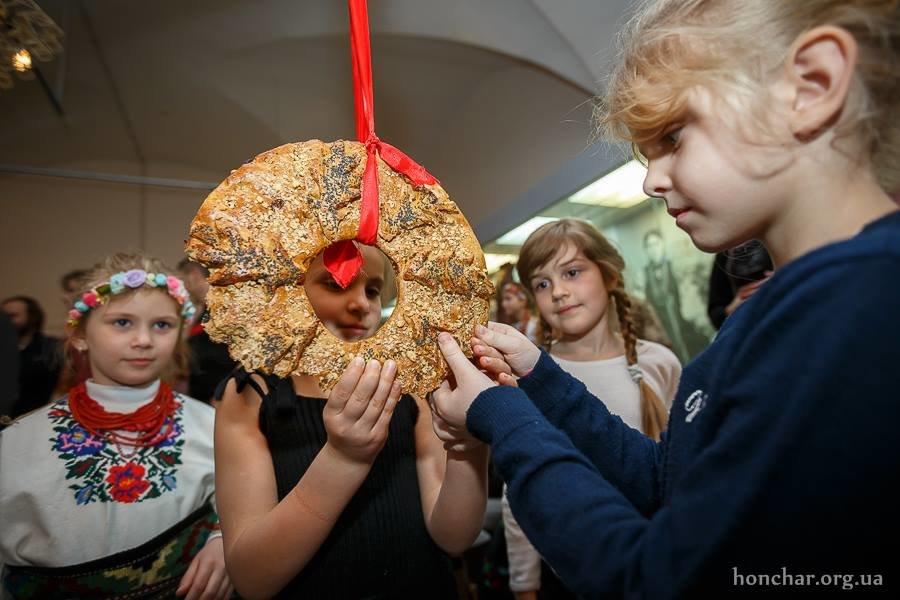
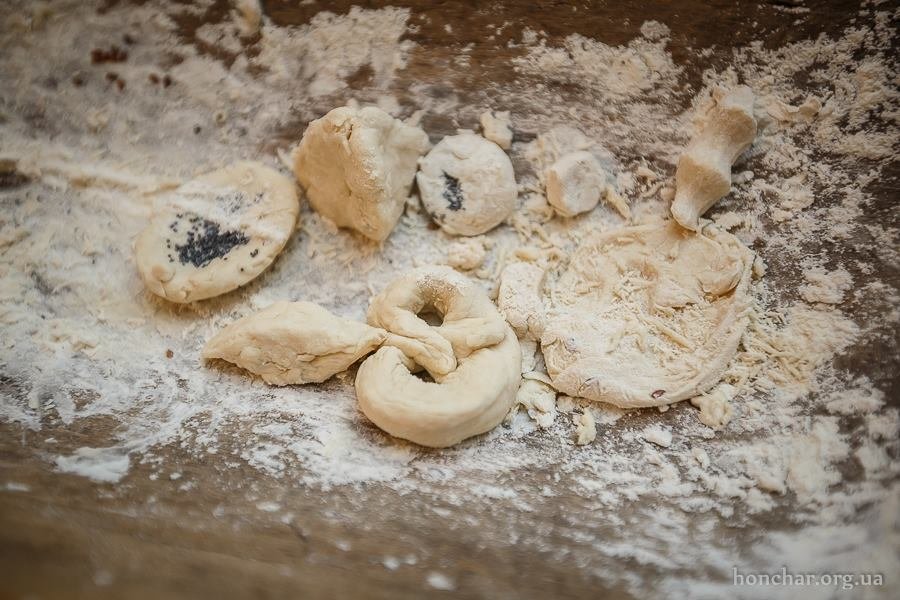
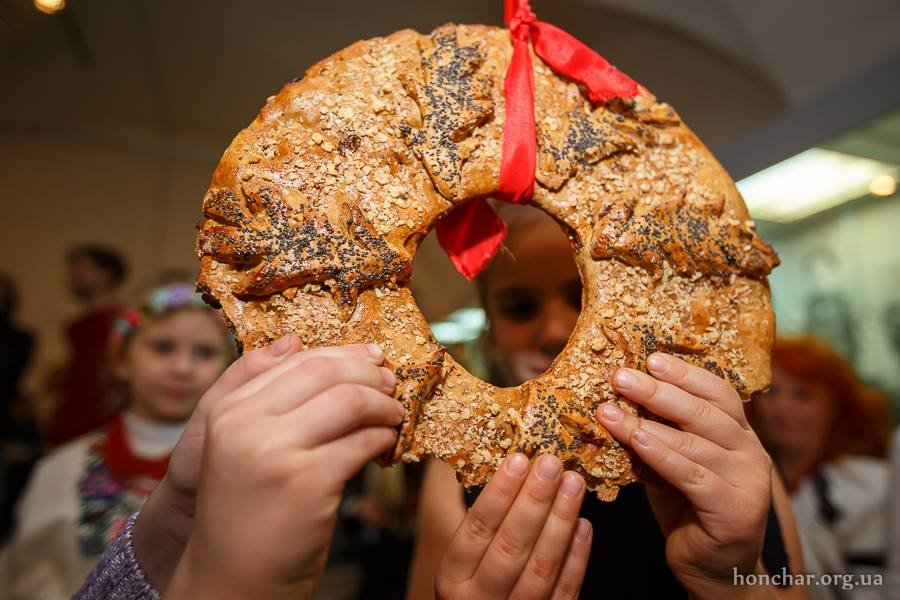
In a house which was particularly rented for celebrating, girls were doughing up to make a kalyta. It was a custom bread which was baked only for the St. Andrew’s Day. It was baked in the form of a big round cake with a hole inside of it. It was made dry on purpose to make it harder to bite. Kalyta was coated with honey, raisins and poppy, sometimes with guilder rose. When it was done, young men hung it to a joist with the help of a girl’s red belt or strip. There a ritual began.
Kalyta had its own guard Mr Kalytynsky who was holding the end of the strip in on hand and a tag guy greased in cinder in another. It had to be a funny young man with a good sense of humour, “the soul of the night” as Oleksa Voropai wrote. A pen-pusher sometimes helped him. He was standing by a tag guy with a bowl full of cinder with water.
A fire hook and oven fork were lying under kalyta or just nearby. Participants had to jump fast over without touching them while a song was playing. If somebody failed, a pen-pusher greased his face with cinder.
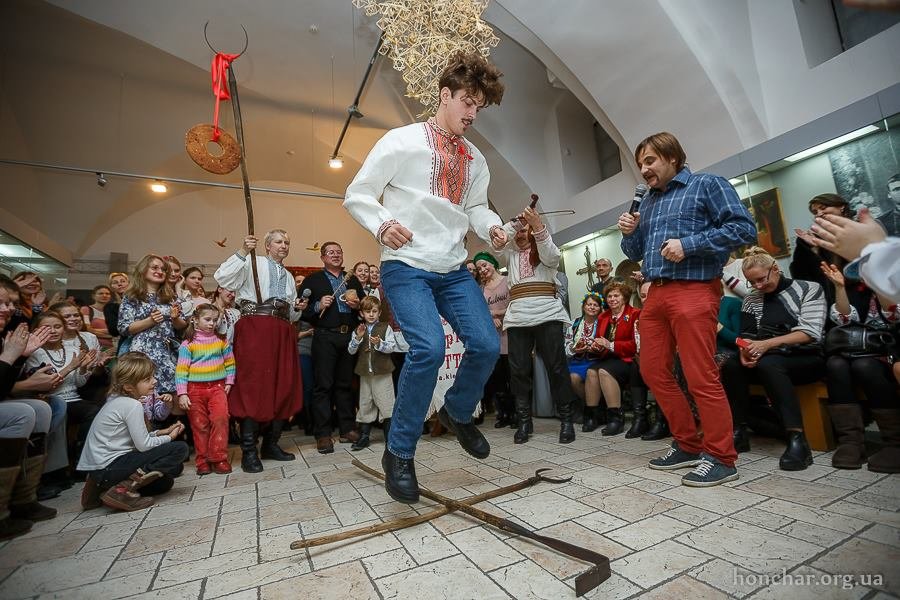
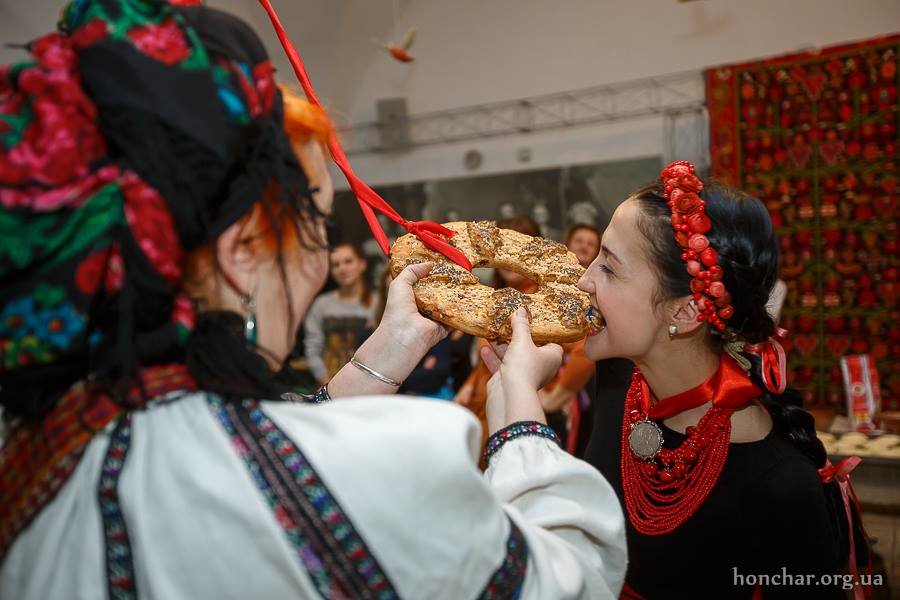
If a young man managed to do it, he took a fire hook, straddled it up and rode to kalyta. Now he was Mr Kotsiubynsky (kotsiuba is a fire hook in Ukrainian). Then, there was such a dialogue:
“Good evening, Mr Kalytynsky!”
“Good evening, Mr Kotsiubynsky!”
“Where are you going?”
“Where the kalyta is, to bite it.”
“And I will write it!”
“And I will bite!”
“And I will write!”
As Oleksa Voropai says, Kotsiubynsky can bite kalyta only after he hasn’t laughed to any of Kalytynsky’s jokes. If Mr Kalytynsky saw Kotsiubynsky smiling, he (sometimes with the help of the pen-pusher) greased a participant’s face.
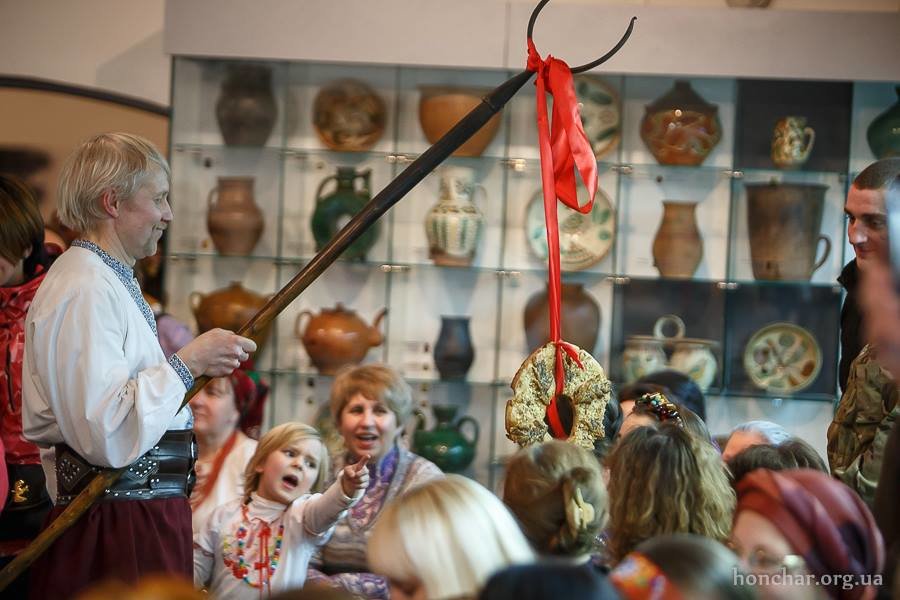
In some areas, only young men were allowed to bite kalyta. Only in the end, if something was left, the cake was equally divided among girls. In western Ukraine, only girls were jumping to bite kalyta.
What does kalyta symbolize?
Actually, researchers still don’t have a common opinion towards this issue. Oleksandr Potebnia, for example, said that a round form of kalyta which was baked just before the day of the winter solstice was connected with an ancient cult of the sun. Mykola Grushevsky wrote about a similarity between Ukrainian custom bread and French pain de calende and Albanian kolendra which was baked just before Christmas and given to carol-singers.
This is why the name “kalyta”, as well as koliada (house-to-house carolling during Christmas), originate from the ancient Rome celebrating which ended an old year and started a new one. During the sun solstice, an old sun was symbolically dying while a new one was being born. According to most of the researchers, kalyta was a solar symbol and, perhaps, a sacrificial offering to a peasant god of the sun.
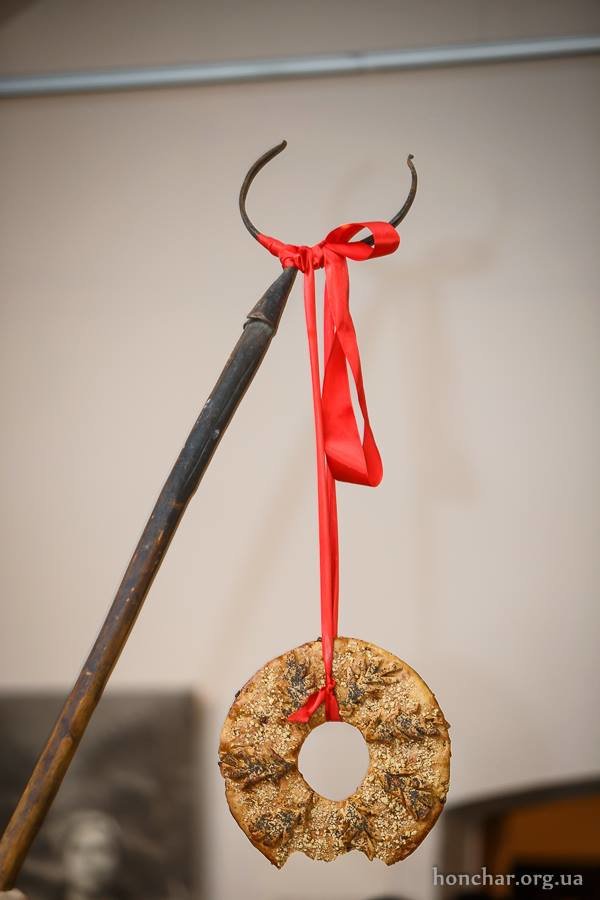
However, this explanation isn’t quite full if one important detail is omitted. Namely, an erotic subtext of agricultural customs, which always used a magic of similar (when people bodies’ actions have to boost ground’s forces). So if we look at biting kalyta from this point of view, then a competition for a round cake with a hole inside of it, decorated with red berries and hung with a red strip (the symbols of feminine virginity), we can see it all quite differently. Don’t forget that only single young people could participate in this ritual. It means that kalyta not only symbolized a woman’s body, as Eleonora Narvselius (Havryliuk) states but also was an object of wedding fortune-telling (in the regions where those were girls who jumped).
As you are likely to have already mentioned, this ritual had one more peculiarity. Mr Kotsiubynsky isn’t allowed to laugh. Such a rule was applied in the rituals connected with the transit or approaching the world of the dead who, according to a traditional culture, can’t laugh. This is why it is forbidden to laugh during fortune-telling as during this time there is a communication with another world is on.
It is also the reason why non-laughing and temporal non-speaking was typical for brides during weddings. The point is that transiting to a new status was believed to be a ritual death in one guise and the birth of a new one. During these rituals, the main participants had a challenge of becoming similar to the dead (they couldn’t laugh, speak, eat, touch others etc.).
Taking into account all the above, biting kalyta doesn’t seem a simple tradition anymore. It conceals much more secrets.
Does this ritual still exist?
It doesn’t exist as it used to, however, Ukrainians could participate in it during studying in a college if they had vechornytsi there or if they visited museums of a traditional culture. Ukrainians are also most likely to face this ritual at elementary school. It is often conducted at schools.
As for me, I learnt about kalyta when was visiting a Kyiv elementary school. Just in the middle of a lesson, a teacher entered our classroom. He was dressed in wide trousers (sharovary) and had a stick with a red strip and a kalyta bound to it. One by one, we were riding on a mop or broom (what we had in our classroom) to Mr Kalytynsky. Then, if we failed to jump to kalyta and bite it, our faces were drawn with a piece of chalk. We extremely liked this game and I remember well that we were waiting for the St. Andrew’s Day because of this competition. This is how this ritual is perceived today. This is not the only case when folklore starts to be used by children instead of adults.
For example, fairy-tales Slavic children have been told a tale about a journey into the world of the dead. They were told not to kids but to those who were preparing for a transit ritual – kind of an instruction of what is waiting for you in a cave or forest. Hide-and-seek game also originates from funeral rituals. The one which catches with close eyes symbolizes the death which seeks for another victim. People believed that if they played those situations in a real life, they wouldn’t happen to them. In fact, almost all ritual songs are now sung by kids in kindergartens. However, they used to be sung only by adults.
It is a consistent process when folklore becomes more childish. It happens when an original sense of certain traditions is erased. Such a tradition usually is conducted just formally, mechanically, but without realising a real sense. Folklore pieces are sometimes taken by children and catch on within their environment (as it happened to some games, adages and ritual songs), or given to children by adults (like fairy-tales and some horror stories). Sometimes traditions are fully reconsidered and get a new life. Biting kalyta is most likely to get into the latter category.
Text by Daria Antsybor
Photo by Bohdan Poshyvailo, from the collection of the national centre of folk culture Ivan Honchar Museum