
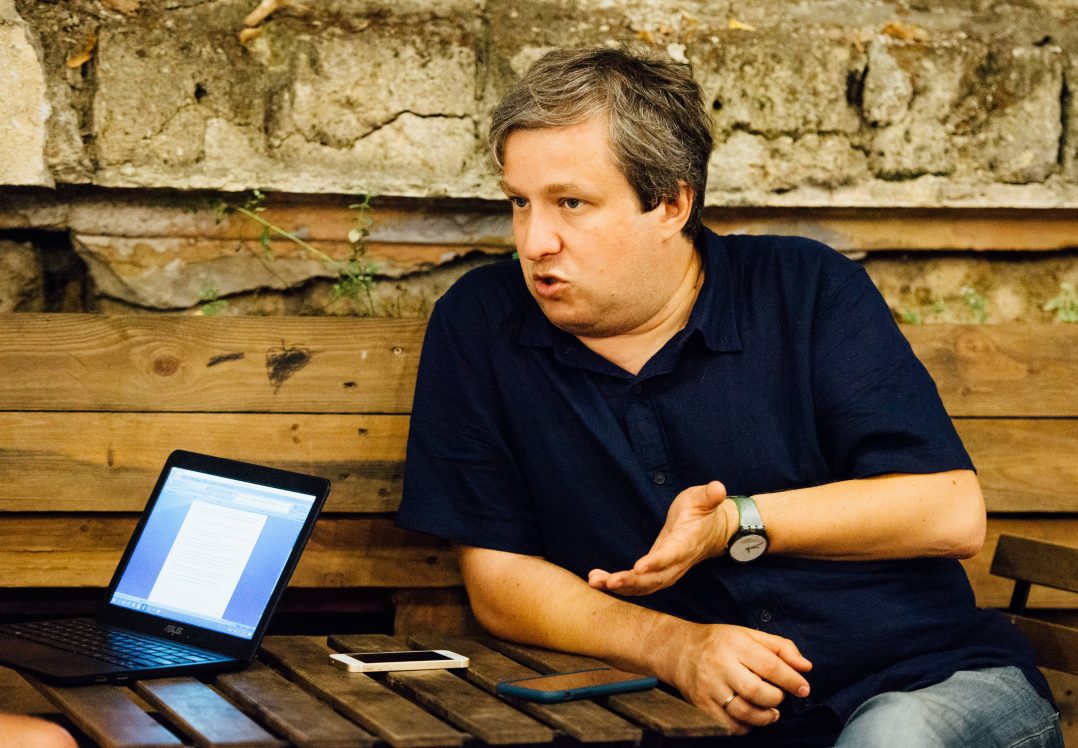


Anton Dolin, A Russian film critic, is the most influential expert of cinematography in Eastern Europe. He writes reviews for The Hollywood Reporter (and dozens of other magazines) and attends many world festivals. DUMKA spoke to Mr. Dolin about Ukrainian films, a real Russia’s attitude to Sentsov and, unexpectedly, about the Ukrainian censorship.
Last year, a Ukrainian film “A Gentle Creature” by Serhii Loznitsa was included by you into the top 10 “must see films”. Are there worthy Ukrainian films this year?
Unfortunately, Ukrainian films are not shown in Russian cinemas. I am afraid there are pragmatic, not political reasons for it. Thus, my knowledge of Ukrainian films is limited by those which I can watch at international festivals. I saw the film “When the Trees Fall” in Berlin, and it seemed to me a typical post-soviet poetic film. It isn’t bad, but you want something absolutely different from new films in language as well as in attitude regard. Unfortunately, I haven’t seen the “Volcano” and some other Ukrainian films which have been appreciated lately…
As for Loznitsa’s films, I doubt we can call them Ukrainian ones. He is a cosmopolite and a European, he was born neither in Ukraine nor in Russia, he was brought up within several countries and cultures at once: in Soviet, post-soviet and anti-soviet. Nevertheless, his film “Donbas” is definitely very powerful. Not as powerful as “A Gentle Creature”, which impressed me a lot. I have watched his documental films as well: I liked “The Victory Day” much, and I am very lucky to have seen it.
However, at the main Ukrainian festival – the Odesa International Film Festival, the Grand Prix was given to a Belarusian film “Crystal”. Is it just the 90s theme or the film is special itself?
I haven’t seen “Crystal” yet, but I am the 90s person and this topic has always been interesting for me. It is clear that this epoch with its chaos and specific romantics grew up from Perestroika in the last years of the USSR. As a current epoch grew up from the 90s. All politicians who today run Russia, Belarus, Ukraine were shaped at that time. That’s why it can’t fail to be relevant. The other point is I can hardly find a consistent and deep analysis of that epoch, the Genesis which would be really interesting for me. I can see this analysis in the Svetlana Alexievich’s “Secondhand Time”, but I can’t recall a film which shows It vividly enough.
There was a big scandal after the award had been received. It turned out that Husky, a Russian rapper, who supported “the Donetsk People’s Republic” and expressed his certain political opinion, played a small role in the film. However, he says only a small phrase there. What do you think: is it a failure of the creators or just the society demands too much?
My position on modern Ukraine may seem wild and marginal, but I believe that a public position of people and their activity in the art are not connected at all. I think that stop lists of actors who think something wrong about Crimea and Ukraine are just wild. I understand when they declare opposite ideas to your national policy. But I don’t understand how it is connected with their good or bad acting in films or plays. They play their roles, why does it matter? Russia with all its censorship doesn’t have anything similar to it. Books of Ulitskaya and Akunin, open opposition authors, are put near books of Prilepin in bookshops. And it is OK. I think it is right when people can choose for themselves what to read and watch and what not.
Nevertheless, some films are banned in Russia.
Yes, for example, “The Death of Stalin” is banned, I think it’s wrong. In this situation, authorities treat their electorate as small children who can be allowed or not to do something. Ukrainian authorities treat their electorate the same way now when they ban some cultural products, basing on their ideological beliefs. I know that it is strange for a Russian to say such words about Ukraine, but it is a road to the Orwell society. That’s why I approve of neither censorship in Russia nor in Ukraine. It only interferes with culture and never helps to develop it.
Especially when artists are imprisoned as Kirill Serebrennikov and Oleh Sentsov.
The majority of Russian citizens have never heard about Sentsov and even about Serebrennikov, while the minority believes in the TV propaganda. They think that Sentsov is a terrorist who has declared a hunger strike, while Serebrennikov is a fraudster who has stolen much money and that’s why he is put to prison. There is a small group of people who think independently and can analyze facts, and who don’t take for granted information from state channels. They know that Sentsov is a victim, who has been slandered, and Serebrennikov is a prominent director, who was turned into an economical criminal via some manipulations. That’s why different people treat this situation in different ways in Russia.
After the Serebrennikov case, are directors afraid of taking money for films from the state? The State Committee for Cinematography has recently begun widely supporting Russian films.
It is OK when a state gives money for art, but this mechanism needs to be deliberated. I think it is absolutely wrong when money is given only to films which are “ideologically appropriate”. I mean any film in Russia or Ukraine which criticizes the government won’t receive any help from it. An artist, if he or she is a great artist, has to report only for the fact the money was really spent on the film production. But their position doesn’t have to reflect the position of the government.
In this regard, it would be interesting to know why the film “Babiy Yar”, which was made up by Loznitsa many years ago before Maidan, can’t still get funding from the government. It is evident that this film will go to international festivals and catch the attention of the whole world, that Babiy Yar is a huge tragedy, which needs a representation in art. I don’t want to believe that modern Ukraine doesn’t want to see a story how Jewish people of Kyiv were killed not only by Germans but by citizens of Kyiv either. It is a historical fact, and a fair state can’t be developed without revealing a true history.
Nevertheless, Ukrainian cinema raises grave topics.
Ukrainian cinema is terra incognita. It is the cinema which we don’t know and which I crave to watch. I am sure but for this terrible war, Moscow and St. Petersburg could host Ukrainian films at their festivals. But it doesn’t happen – there is an unspoken blockade. Nobody restricts to show Ukrainian films, however, none of the cinemas dares to show them.
We seem to have the “mirror” situation.
On one hand, I’m happy your cinemas don’t show our “Tanks”, on the other hand, it is sad that you can’t see dozens of modern and decent films.
Can we establish a dialogue today?
We have to do one thing: to stop the opposition between Russia and Ukraine. We have to stop deaths of soldiers, civilians in Donbas and even those weirdoes who go there to fight for “the DPR”. People have to stop dying. While there is the war, we can’t hope that people of art will make a look as if there is no war.
Interview by Kostiantyn Rul
Photo by Pavlo Lebedev