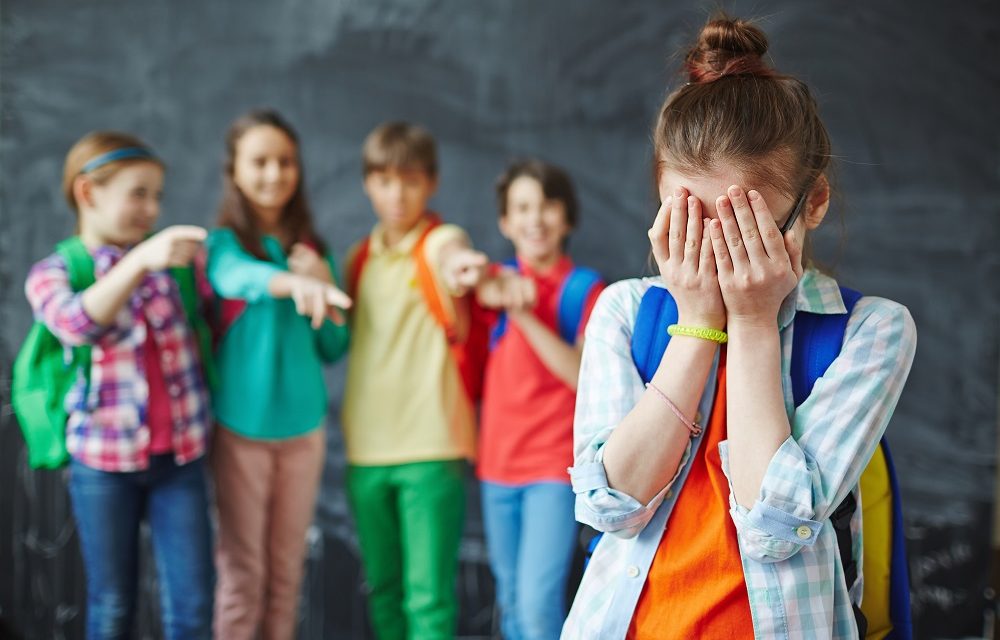


In early August, the social media was outraged by the brutal video of the beating of a teenage girl by her peers in Odesa. As well as similar stories last year from Chernihiv, Ivano-Frankivsk, etc., this video divided the public into two camps: some sympathize with the victim, others persist in aggression, sighing for modern children that have become more violent, and try to find out who is more guilty – school or family. After all, during the past year, according to the director of the Directorate of Inclusive and Out-of-School Education of the Ministry of Education Larysa Samsonova, there are 109 thousand appeals of children and their parents on bullying at school.
In response, the Ministry of Justice has already launched information campaign #StopBullying. The Ministry of Education plans to counteract baiting in schools. And the deputies initiated a bill that provides punishment for bullying and in which the teachers are responsible… in the form of fines – from 340 to 850 UAH.
Meanwhile, bullying is not a new phenomenon. Let us recall the scandalous tape of Soviet times “Scarecrow” by Rolan Bykov. About whether this phenomenon has become more widespread; which children are at risk; what are the specifics and the reasons for the Ukrainian bullying, and what should we do with this, we talked to the practical psychologist of the City Child Center (Kyiv) Natalya Pashko.

Mrs. Natalya, has bullying become more wide-spread today? If so, with what, in your opinion, is it related?
This phenomenon actually existed before. However, now it has been named. There are many cases of harassment. And it’s very difficult to say that this is a pure bullying.
As far as I have noticed, the issue of the bullying was “warmed up” after the outbreak of hostilities in the country. I work with children and I remember how even those, who haven’t seen the war, experienced it. Children have mystical thinking. And at a certain age, when they hear something, they believe that it can happen just beyond their door.
The war reduced the general sense of security and stability and increased aggression in society. Security exists on several levels – the country, society, school, relationships, the family. Infringement of safety now not really revealed an issue of bullying, but emphasized it.
In addition, the school space itself is often quite competitive. When six-year-olds go to school, they are not so big friends with each other as they are fighting for the important feeling for this age “I’m a fine fellow”. And here the position of the adult, the school, the ability to notice “the young person” in every child is very important.
I work a lot in schools. And I see that, unfortunately, there has been a self-elimination of teachers from the processes of solving children’s conflicts. In addition, now we have any information immediately uploaded to the Internet, and many teachers prefer not to do anything, than do something and then be afraid, whether the parents will appreciate it.
The focus is not on the formation of relations between children, not in the adaptation of a child to school (not in terms of assimilating conditions and requirements, but in terms of team building, including the extracurricular activities, events). From an early age – both in the family and at school -everything is imprisoned for intellectual pumping of the child, success, purposefulness. In school – these are indicators, ratings. If you are the best, you will be able to break through in your life. The survival instinct is so strengthened, and the emotional intellect and values of relations “fade away”, the children cease to be empathic.
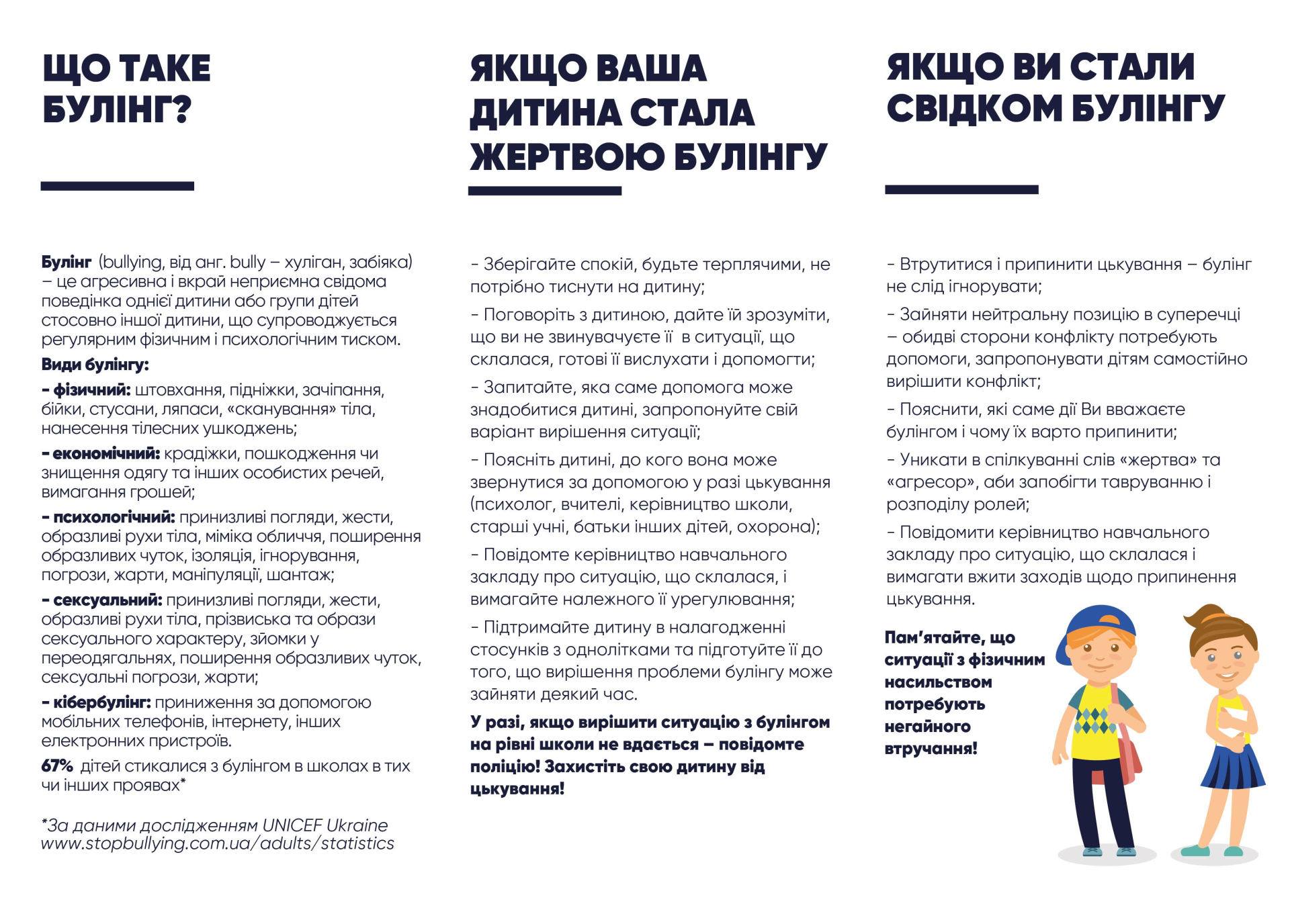
Source: Ministry of Justice of Ukraine
According to UNICEF, in 2017 about 67% of children experienced bullying among peers in Ukraine. These figures are impressive.
I take the figures very carefully. I don’t know how they can convey any topic. High numbers can mean that people already know what bullying is.
But look, the media in the news place an emphasis on the fact that everything is bad in the country, and on the aggression. Popular among teenage children videos show aggressive sexuality, the cult of a strength, rebels.
Physical and psychological violence within the family is a frequent occurrence. At the same time, psychological violence often is underestimated by us. However, the psychological violence, traces of which cannot be seen, remains the child’s inner voice and affects his self-esteem.
Self-esteem is formed from birth when the mother holds a child and satisfies its needs. From the way mother does it, with love or through aggression, a three-year-old child has a basic attitude and understanding: who am I, who are adults and what is the world. Accordingly, if at this age there was ignoring, rejection or aggression, it becomes the child’s inner voice. For example, “I’m bad”, “They do not need me”, “The world is bad, I have to do everything myself, adults don’t notice my needs”. And children with clenched fists go into this world, building contact with it through the position of strength, with which there is often an unmet need for attention, great fear, and anxiety.
Unfortunately, I see that in the media now a very great emphasis is placed on the victim of bullying and attacks on the aggressor. And completely ignored are the children, who witnessed it. My position is this: all have suffered – both, the victim, the aggressor, and the witnesses.
Psychologists are often brought to the victims. But the aggressors are being, rather, evaluated, they “sort out” with them. Now we have in drafts the term “child-offender”. But he’s also a victim and needs help. As well as witnesses, whom today the law equates to the victims.
Children don’t hear us. They are looking at us, how issues are solved, how the relationship is built. Children see a lot of aggression, they are not taught to be empathetic, build relations and ask for forgiveness. And it all just becomes the norm and the truth of their life. Just like, for example, setting that you need to endure. After all, often when a child says to an adult “no”, an adult is indignant: “How dare you?” And thus it cultivates the victim or passive observer, forming internal attitudes.
The first big society for a child is a school. And when a child comes there with the task of his or her age to assert oneself through the assessment of an adult (how good am I?), then, considering that adults are eliminated, focusing only on estimates and indicators, unhealthy competition to be the best begins.
Empathy, the ability to empathize, does not appear by itself. Often parents forbid children to show feelings, do not teach how to cope with them. But the feelings do not go away, they accumulate, and the child is looking for a place where it can show them. If a child cannot do this at home, then the next place is to become a school. And as soon as some factor appears, the child reacts to it no longer by irritation, but immediately by an explosion of aggression that it cannot control. One girl told me: “For so long I kept all this in myself, I was like a volcano. I just wanted to get rid of it. There was a situation, and I didn’t notice how I beat the girl and couldn’t stop”. And the problem was not even in that girl, who became a victim, but in a relationship in a family, where aggression was directed toward the offender. Children often keep silent about this.
And here is the question of boundaries. Adults often violate the boundaries of children, do not teach kids to keep them. But if the child understands that there are boundaries and it has the right to protect them, then another person is obliged to respect them, thus, the children will learn to do this also to the other children. Bullying – this is what we do with the children if we don’t participate and ignore. This gives a rise to aggression.
In the stories that I know, the witness girls said: “I didn’t agree with what was happening. But I understood: if I refuse, I am the next”.
The aggressor, the victim, and the witness… If at home or in any place the children are victims, then they try to regain control over their lives, applying this aggression in another place. It turns into a vicious circle.
The biggest difficulty now is the reaction to these topics. School, adults, society are included in the evaluation and protection of one person.
What kind of children and why are victims of bullying more often?
I think it’s not necessary to draw portraits here and try to clearly identify the types. Unfortunately, this is what leads to the bullying. Of course, we need some benchmarks in order to be involved in time.
For me, all children are in the risk group: both victims, and aggressors, and witnesses. If a child has experienced violence, it will apply this also to the others. Children that are stronger psychologically fight back, and carry it on, trying to regain strength. There are children, who suffer from violence, and cannot respond. They become victims. It’s rather about the positions, not about the types. And they are constantly changing.
If the experience of the child hasn’t been developed from all sides, it goes with that further, as with a suitcase. And this box of Pandora explodes at some point. Because it is this experience and feelings that the child tries to get by.
Sometimes the cause of a child aggression may be some kind of specific functioning of the brain or nervous system. In connection with his physiological state, the child cannot assess and control the situation. Exhaustion of the nervous system can also lead to social maladjustment. I do not have statistics, but the number of such children is growing.
What, in your experience, is the special trait of Ukrainian bullying?
Culturally, we have a very large ban on aggression – the basic emotion that helps us to defend ourselves, to show that our borders have been violated, that it hurts. The context of constructive self-defense is erased in those children, whose borders are often violated.
Children learn to defend their borders at the age of three. At the first stage, the child tells his mother: “Do not touch me!”, “I do not want!”, “I won’t!” This is the first experience of showing the border.
If this is ignored or there is an aggression in response, the child later tries to draw boundaries by his behavior – to push somebody or something like this. I, in return, it receives aggression again, it finds out that aggression is the norm, and if my limits are violated, I will beat. Or even worse – attack myself, so that no one can offend me.
When in school some processes passes unnoticed, no one tries to figure out how it all started, no one is investigating the story of the aggressor (they only evaluating and truying to punish him or her), the question is not solved. What is most terrible is that this child is only stigmatized as the aggressor. This can scare the child for a while, but next time it is even more hateful to the world.
If we talk about teenagers, then they have hormonal storms, they are impulsive, emotional and partly aggressive. What happens to their body, when the bones, muscles, grow dramatically, makes them irritable and hypersensitive. They can react inadequately to words.
On cultural specifics – we need to learn to perceive aggression not as “you are bad and evil”, but as a feeling that allows you to show: my limits were violated. It is necessary to teach children to cope with aggression, to show that being angry is also normal. If we continue to put bans and stigmas, then it comes to extremes. After all, irritation and anger don’t disappear anywhere. They accumulate. And thus the child is at the point of rage and anger, breaks down, destroying himself and the one, who is weaker.
That is, is it needed to learn how to redirect aggression?
Redirections are the same as leaving. It is about the ability to manage and express aggression by constructive means. To begin with, take the child’s right to be angry. If we forbid a child to be angry or react to one’s “no” with aggression, respectively, the child will try to break our bodily boundaries with one’s anger and strike. You can say: “I see that you are angry. But I don’t let you beat me. And I don’t allow myself to beat you”. Unfortunately, often an adult believes that he or she has the power to hit a child. The child does not have the power to hit an adult. But the child is growing…
What signs indicate that the child was a victim or, on the contrary, an aggressor in a children’s collective? How can we help?
Sometimes parents think that if the child doesn’t tell, there are no visible symptoms, then everything is fine with it. But the same “everything should be good”, “don’t upset your parents”, the lack of a culture to talk with children could be the reason that the child does not speak with you. The indicator of good relations in the family is when the child can come to the parents on the different occasions – joy, sadness, etc. And the child won’t be evaluated, but heared.
In a conversation, children don’t always need an adult to give some advice or assessment. Sometimes there is a need to just share. And if you perceive it, you will be able to recognize the signs that the child needs help.
Children cannot always assess their condition. Even if you ask an adult about how he or she feels, most people will say “OK”. Children should not be asked about the marks they received today in school. But about what struck them today. Then the children will begin to analyze themselves, understand what they feel and, accordingly, share it with others, counting on help.
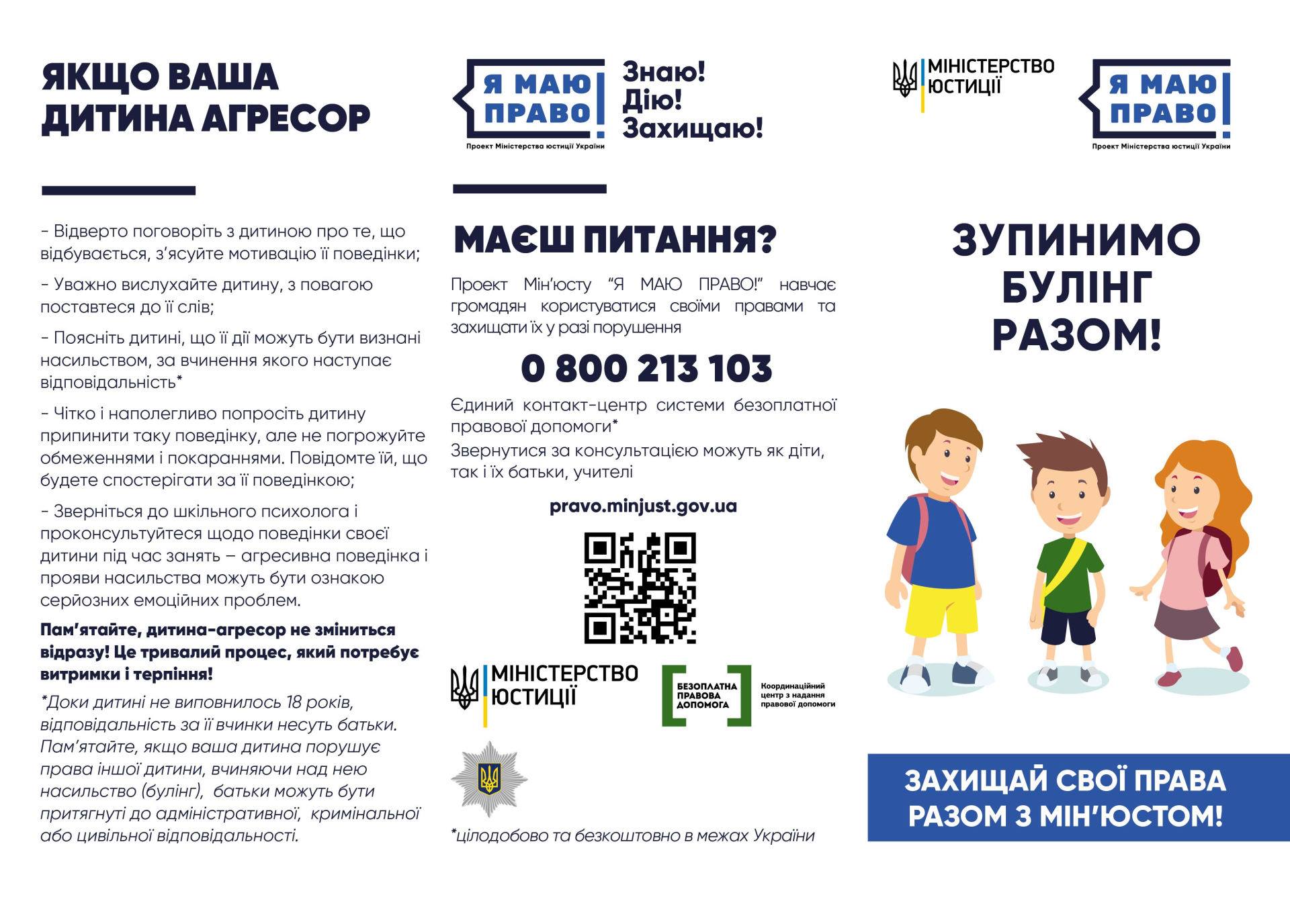
Source: Ministry of Justice of Ukraine
Unfortunately, when my colleague and I made a “helping hand” for children, who suffered various types of violence, it turned out that the percentage of those, who can turn to their parents is very small. Children are afraid to upset parents and get an assessment from them; they are afraid that the situation will become even more acute.
Because of their work, because of the lack of experience to share with their children, parents don’t notice the symptoms. A child comes to them often when, as they say, “the house is on fire” or someone has already told their parents.
Violence and grief often have no traces. Sometimes it’s easy to see. The child can hide it. And, accordingly, remain with his misfortune on it’s own, at some moment finding himself at a point from which he doesn’t see a way out.
Once again: the children do not listen to us, they look at us. And often they see that mom and dad don’t talk, and if they share something with each other, then only problems. It’s summer now, and I notice that families cannot rest together.
Another problem – “keeping the incident in a house” is very wide spread. And this turns into the fact that everyone in the family becomes an outcast, doesn’t show close feelings. The ban on feelings gives rise to all these problems.
Speaking of very serious symptoms, the child becomes too comfortable, quiet, trying to distract attention from oneself. Unfortunately, parents are accustomed to interact with the child only when everything is bad. And when a child feels bad, it cannot withstand the parental state of anxiety.
There is a violation of basic things: sleep, food, hygiene. The child closes in the room and doesn’t want to go anywhere. Excessive quick temper for those that previously reacted calmly.
In my experience, children often talk about this to their parents a little. After all, the child does not immediately turn to the point of despair. It shares what happens in the school. But adults tend to depreciate, listening only the answers to questions about the marks and made homework. When a child talks about Masha, Vanya, Petya, what amazed him or her, it often hears: “Do not worry!” Or “Do not exaggerate”.
Children talk. Less often – by words, more often – by behavior. But we “sharpen” them for success, don’t teach how to obtain relationships and lose our own ties with them. Therefore, faced with a serious problem, parents are amazed: everything was good…
You said that very few people are exploring the story of an aggressor. One of the biggest problems here, in my opinion, is his parents, who don’t want to notice the problem: “My child could not do this”
On the one hand, the aggressor’s parents don’t want to notice, because they can partly feel guilty, because then it will appear that aggression is also the parents’ method. Some parents say: “You need to beat a child. Otherwise, it does not understand” or “I hit, because I want to make a person out of it”. This is the attitude to the child like to a thing. Thus, the child begins to treat others the same way: if it does not like someone, it hits.
On the other hand, when the fact of bullying is revealed, the aggressor’s parents see themselves in the child and want to protect themselves, they do not want to understand.
And this is a big problem. One part of society is aimed at stigmatizing the aggressor-child. The other – to sympathize the victim. But this doesn’t lead to anything good, because in every victim lives a rapist. It is necessary not to divide in the camps, but to approach the study of this topic systematically, without ratings and cliches.
Let’s say that the fact of bullying is stopped. Is it necessary to withdraw the child from the environment, which became traumatic for him?
The bullying theme is very systematic. This is not at the level of the conflict of children. This is also the school, its administration, society. This is a huge layer of work, a willingness to disclose the topic and work with it. Unfortunately, now such situations are being resolved at the level of physical displacement and disengagement. Perhaps this is one of the solutions. But if at school, in society, they choose not to consider this issue, this problem will not be solved. If the teacher decided to stand back and for him or her it’s kind of normal in this way to give permission for bullying, then instead of aggressor Petya, tomorrow will appear the aggressor Vasya. If the school administration is afraid to say that there is such a problem in the school (you cannot take it out of the house, or the prosecutor comes with a check), then this topic will continue. After all, even checking does not solve the problem, only extinguishes the fire here and now.
If the norm for us is to educate children through violence, there will be a bullying. It will be, until the society will learn to talk about different things and do not evaluate others. In order for a child to change its behavior, it needs to be given a new way before taking away the old one. While we, as adults, will solve the problem with the help of aggression, we will not teach a child anything else.
Interviewed by Hanna Drozd