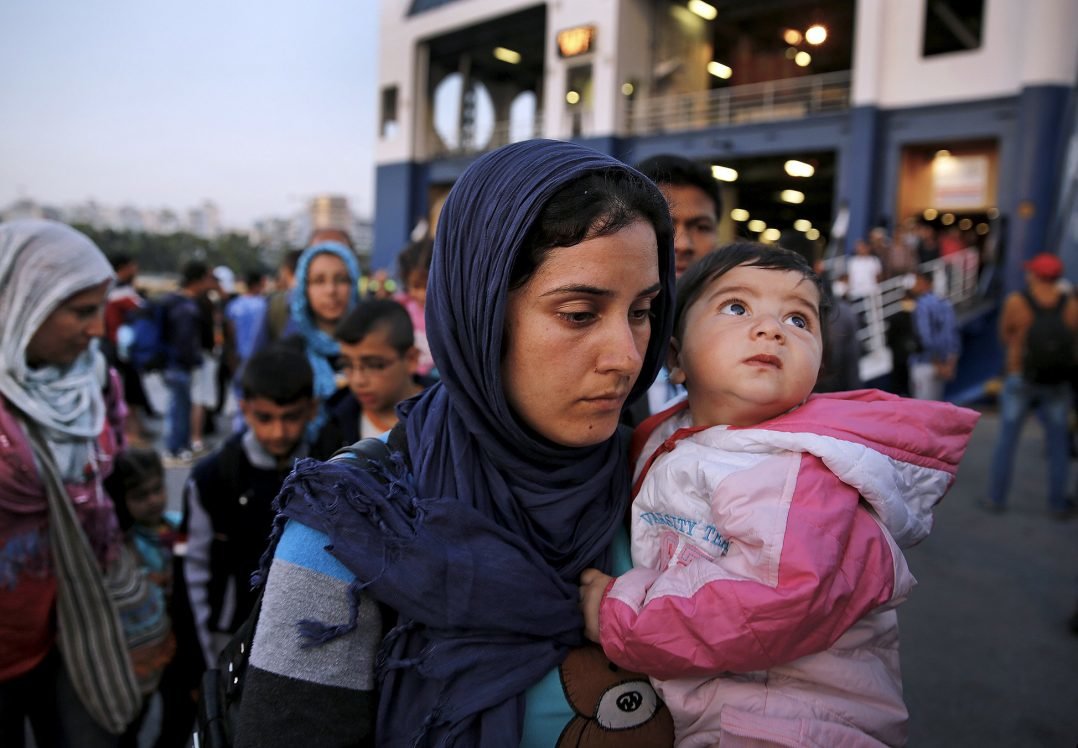


The information about the mass death in the Mediterranean Sea comes regularly. So, on June 12-13 near the coast of Libya, about 220 migrants were drowned – three boats that tried to reach the south of Europe were wrecked, UNN reports. And only a week later, on June 20, World Refugee Day, was an occasion to remind all mankind of this urgent problem. How does Europe solve the issue of migrants? What is the role of Ukraine in this process?
Price-Tag
The theme of refugees does not disappear from the agenda. On June 28 and 29, a regular EU summit will be held in Brussels. In particular, the problem of migrants, who come massively to the Old World from the Middle East and Africa, will be raised. Among the reasons to leave home and look for a better shelter in prosperous Europe, there are overpopulation and a shortage of jobs, military conflicts and a high probability of natural disasters.
In the EU, the situation with migrants is perceived painfully. The media reported that German Chancellor Angela Merkel intended to meet with individual European leaders before the summit. Among the states that urgently need to address a pressing issue: Italy, Greece, Austria. The participation of the leaders of Spain and some of the Balkan countries remained questionable. Subsequently, the press service of Merkel denied the information, disseminated by the media, about the preparations for the urgent meeting of the leaders of the mentioned states to solve the problems of migrants. Is the topic really so acute?
“Regarding the size of the EU, the issue is exaggerated, since the number of refugees is small compared to the total population of the European Union”, Iliya Kusa, an expert on international politics in the analytical center “Ukrainian Institute of the Future”, said to DUMKA. “If we talk about individual countries – Italy, Greece, Spain, Germany, Austria, this is a more pressing problem for them. Especially for Italy, it took many refugees. So, the issue of migrants is quite acute but politicized. And in certain countries it is considered in the pre-election discourse”.
A lot of political speculations are also seen by international expert Viktor Savinok. However, he admits that the countries on the main migration routes suffer most from the excess of migrants. It is primarily about Italy (the western Mediterranean corridor) and Greece (the Balkan corridor). The problem creates a strain on their economies and administrative systems, adversely affects the welfare of citizens, and requires a pan-European solution.
“As for the pace of refugees’ arrival in the EU, compared to 2016, the intensity has significantly decreased, in particular due to the measures taken at the EU level, including the migration agreement with Turkey”, Mr. Savinok noted for DUMKA. “The problem is that after all, the EU has not been able to find a consensus on the migration issue and how the implementation of the so-called Dublin agreements will take place, which in fact stipulate that migrants remain in the countries they have arrived to. And the attempt to distribute refugees, bypassing these agreements, was unsuccessful because of the position of the countries of Eastern Europe and the Baltic States, that do not want to accept several thousand migrants. Although, it is unlikely that they constitute such a critical danger to the population and culture, as noted by their governments”.
Germans and refugees
Each state, taking refugees, is guided by the domestic legislation on the situation and conditions of stay of foreign citizens on its territory. Many experts are convinced: to resolve the issue, it is necessary to introduce the only normative document in the world that would regulate the recognition of refugees, facilitate their employment and determine rights. However, influential institutions have not taken seriously the development of relevant legislation.
In Germany, a conflict arose in the highest governmental and party circles. The Head of the Ministry of Internal Affairs and the leader of the CSU (Christian Social Union) Horst Seehofer intends not to let migrants into the country, whose asylum applications have already been registered in other EU countries. But the Chancellor and the Head of the CDU (Christian Democratic Union) Angela Merkel seeks to solve the problem in a pan-European way. The statements of Seehofer looked so tough that even the disintegration of the ruling coalition in Germany was discussed.
“Maybe the main bone of contention between them was the plan of action on the migration issue, proposed by the agency of Seehofer”, Viktor Savinok explained. “In other words, Germany, which was in favor of a pan-European solution on this issue, will expel migrants, as Seehofer suggests, on its own border to the EU from which they arrived or in which they are registered, and this poses a challenge to the migration policy of Merkel, which she has been carrying out since 2015 – the policy of the state open border”.
According to the latest poll, more than 47% of Germans are on the side of Seehofer. They voted for a tough migration policy, against keeping refugees from the pockets of taxpayers. Seehofer offers demonetized benefits for refugees. Migrants also need adaptation to the conditions of German society – they must learn the language, solve problems of employment, although work for refugees is prohibited by international conventions. The escalation of the migration issue in the CSU rhetoric, in the opinion of Viktor Savinok, is no coincidence, because in autumn the regional elections will be held in Bavaria and the CSU fears that the majority of the votes will be taken by the party of right-wing Eurosceptics “Alternative for Germany”.
Not only the Germans are quarrelling. In the EU there is a conflict of interests between the need to respect human rights, in particular regarding asylum seekers, and populist right and left radical sentiments.
“It even went so far that the Director of the ODIHR (Office for Democratic Institutions and Human Rights), Ms. Ingibjorg Solrun Gisladottir, on June 20, completely criticized the decision of the Italian Minister of the Interior to close Italian ships for ships that tried to land asylum seekers from Africa, saved by humanitarian organizations”, diplomat and international lawyer Vadym Tryukhan, Chairman of the board of the NGO “European Movement of Ukraine”, said to DUMKA. “Moreover, a number of mayors of Italian port cities have criticized the decision of their own minister. Therefore, it is not necessary to expect a total ban of entry for illegal migrants from the conflict zones to the European Union”.
Shelters outside the EU
At the summit in late June, EU leaders must agree to study the issue of creating so-called “regional loading platforms” outside the European Union. These centers will consider asylum applications for refugees even before they reach the EU. It is not excluded that such centers will appear in North Africa. It is not easy to predict how things will look in reality.
“According to certain statements of the French and Italians, there will be agreements with local elites of those countries, in which or through which refugees from Africa and the Middle East come, in order to keep them, – Iliya Kusa said. – That is, there will be a Turkish model. The only risk is that unlike Turkey, there is no negotiating subject in Libya. There are three or four governments, and no one controls the situation completely. I think Europeans will talk to the militants, who control the cities through which refugee flows are flowing. That is, the Libyan route is likely to be closed, but they will take migrants there and build large refugee centers.
From the point of view of morality, ethics and human rights, this is quite cruel. In fact, they will return migrants to the conflict zone and leave them in the camps, which is likely to be financed by the UN, certain humanitarian organizations. These are small budgets, and given the US exit from the Human Rights Council, funding will decrease. This is bad for people. Especially in Libya, where human trafficking flourishes”.
Viktor Savinok also asks the questions of creating “regional unloading platforms” in Libya. Who will protect them, because there is no stable government in the country, in fact, there is a civil war. Are there antiterrorist actions against the local branch of the “Islamic state” and “Al-Qaeda”?
“The problem with refugees is one of the global ones”, Oksana Yurynets, Chairman of the subcommittee on regional and cross-border cooperation between Ukraine and the EU countries of the Verkhovna Rada Committee on European Integration, noted for DUMKA. “The “open door” policy partially led Europe into a dead end. Politicians are looking for different options, how to get out of it, and the decision about shelters lies in this plane. The costs, for example, of Germany for the maintenance of refugees are very large. Only in 2016 from the state treasury it took about 20 billion euros. The price of the “unresolved” issue is very high. The issue of migration requires an integrated approach, and European governments are working on ways to solve problems”.
The way through the Balkans
The emergence of refugee centers is being considered not only in North Africa. There are speculations that such objects can be placed in the Balkans. By the way, in Bosnia, on the border with Croatia, there are relatively small points, which contain migrants. There is a very tense situation.
“Firstly, the local residents are against the refugee centers”, Natalya Ishchenko, Deputy Director of the Institute for World Politics, assured DUMKA. “Secondly, the Balkan media does not hide the criminal situation with migrants. They are full of reports about how a refugee robbed a dairy shop official in Sarajevo or how the refugees fought each other. This news does not contribute to the normal treatment of migrants, who are in the same Bosnia. And the migrants themselves do not want to be there. Why do they need Bosnia and Herzegovina? They even go to Croatia as a transit state. Only few remain there because this is already the EU. But these people understand that they will not get anywhere after that”.
Migrants are trying to cross the border of Bosnia with Croatia on foot. A few days ago, about a hundred people wanted to do so. However, they were returned to the refugee center in Bosnia. There are also dramatic situations when migrants break through the border by mountain roads at night in cars. The Croats had to shoot, they even wounded several people, hidden in the van.
“And on the border with Slovenia, Croats shot under the feet of refugees, so that they did not break through to Slovenia”, continued Ms. Ishchenko. “There is a tough situation in the Balkans, which is positioned not as a fight against migrants, but as the trafficking of human beings and smuggling. And if the European Commission decides to set up refugee camps, this will aggravate the situation, even domestic and social ones. One of these camps in Bosnia is in the place of mass war crimes. People survived the war, did not move away from it, live in temporary settlements, and then there is the invasion of the Syrians”.
Is Ukraine out of the topic?
In our country, there is a war in the East for the fifth year. There is a large number of internally displaced persons. The fight against corruption continues. It becomes terrifying if we add to these problems the theme of external refugees. However, most experts are inclined to believe that, to a large extent, this bitter cup has passed us.
“Firstly, I have not heard any talk about the fact that they will deport someone to us”, Iliya Kusa said. “Secondly, this is our sovereign right, and other countries cannot deport refugees to us. Thirdly, we are not a country that can accept refugees, we have no resources to do so. We are not a transit route, even if there are plans to transfer them from us. To Russia? No. Across the Crimea? And where further? To Turkey? Also no. The role of Ukraine in these processes is minimal. We do not influence the EU’s migration policy and we are not a country to which migrants from the Middle East and Africa actually prefer to go”.
“Ukraine is not an attractive country for asylum seekers”, Vadym Tryukhan believes. “Now there are about 3 thousand refugees, in particular, 1,500 from Afghanistan, about half a thousand people from Syria, 200 from Armenia, 150 from Azerbaijan, somewhere about 130 from Russia and Somalia. At the same time, only three temporary refugee centers operate in Uzhgorod, Odesa and Yahotyn (Kyiv region). They are not enough”.
After the end of the war with the Russian Federation and the stabilization of the economic situation, the number of illegal migrants may grow – they will try to legalize in Ukraine. According to Mr. Tryukhan, the Government should now start setting up several more temporary centers for asylum seekers, including the help of international technical assistance. However, we cannot allow the recent story of the SFS (State Fiscal Service) failure to absorb the quotas, allocated by the EU for border checkpoints.
“The issue of refugees is a very speculative topic and it should be used in the election campaign, which is already beginning”, Natalya Ishchenko is convinced. “But Ukraine has to formulate how it will treat this problem. Each political force should develop a position, how exactly we, together with the EU, will address the issue of the refugees”.
Text: Viktor Tsvilikhovsky