


The last week in the Ukrainian social networks there was a topic for discussion, and unfortunately, something to laugh at: on January 11, amendments to the Criminal Code on rape and violence came into force. And as long as people in your feed are still trying to make posts about the receipt, DUMKA found out all the details from the experts: what was really changed, what is “voluntary consent”, why the changes caused such a reaction, and whether men should be afraid.
What has fundamentally changed since January 11?

Scrolling through numerous and sometimes inappropriate “jokes” of the network users about the changes in the legislation we have missed the most important thing – what exactly has changed since January 11, and why it is not a reason for “humor” competitions, but important and necessary changes. Kateryna Levchenko, Government Commissioner for Gender Policy, explained to DUMKA what is worth knowing about the so-called “sex rules”.
“The most discussed issue is what exactly voluntary consent of the victim means. At the same time, I want to note that attention is not paid to the changing of the definition of the rape itself, which is brought into line with (at the level of definition) international standards.
At the same time, it should be noted that the definition of Article 152 “Rape” of the Criminal Code of Ukraine has changed. Now in the text of the article, it is written that it is a sexual act that involves vaginal, anal or oral penetration into another person’s body using genitals or other subjects without the consent of victim.
By this time, rape in Ukraine was considered solely as vaginal penetration, and Article 153 of the CCU was called “sexual assault in an unnatural way”, and this included anal and oral penetration, respectively. Now, according to WHO and other international organizations, rape is any penetration, using both genitalia and any subject. This is extremely important, as cases of rape over men, crimes under Article 153, were very difficult to prove. However, the effectiveness of changes can only be discussed on the basis of practice. In fact, today, the definition of rape in Ukraine has been brought to those standards that work in most countries of the world”, is said in the comment.
“Voluntary consent”: what is it, and where are the myths coming from?
In accordance with the newly revised edition of Article 152 of the Criminal Code of Ukraine, consent is considered to be voluntary if it is the result of the free expression of the person, taking into account the attending circumstance. However, the very definition itself is not enough. Kateryna Levchenko explained in details how to correctly interpret these words, what each of the parts of the definition means.
Voluntary consent is a conscious agreement, that is, “I said yes, and hence it means ‘yes’.
The result of the free expression of the person – this means that the person said “yes” without any coercion: physical, psychological or moral.
Taking into account attending circumstance – this means that investigators and the court, in the case of a complaint about rape, must consider a variety of attending circumstances that are individually determined for each case.
Around each of these three parts, there is speculation.
Regarding voluntary participation, I recall the legal reference to Article 152, which was found on the Internet in 2016, where lawyers wrote that for the rape incrimination, it should be born in mind that “the denial on words, even a certain physical counteraction, does not always mean the real reluctance of a person to enter such a contact. For example, a man can perceive such behavior of a woman as flirt or shyness”. That is, the woman says “no”, but it should be considered as “yes”.
And this is the reason for many information campaigns being conducted today, experts write that “no” always means “no”. Due to the implementation of the principle of voluntary participation both women and men have to learn clearly say “yes” and “no”.
Regarding the voluntary participation, earlier in the Article 152 of the Criminal Code only the physical influence on the person and the use of a helpless state were taken into account, but now we see that the notion of voluntary participation or voluntary consent now has a broader interpretation.
And around this issue, there are a lot of myths, for example, about receipts. They are not needed. Moreover, the availability of a receipt may be considered as a coercive instrument. You can recall how we usually sign a receipt for the processing of personal data. Did all people read what they sign? I think, not everyone. Therefore, both jokes and receipts themselves are completely inappropriate.
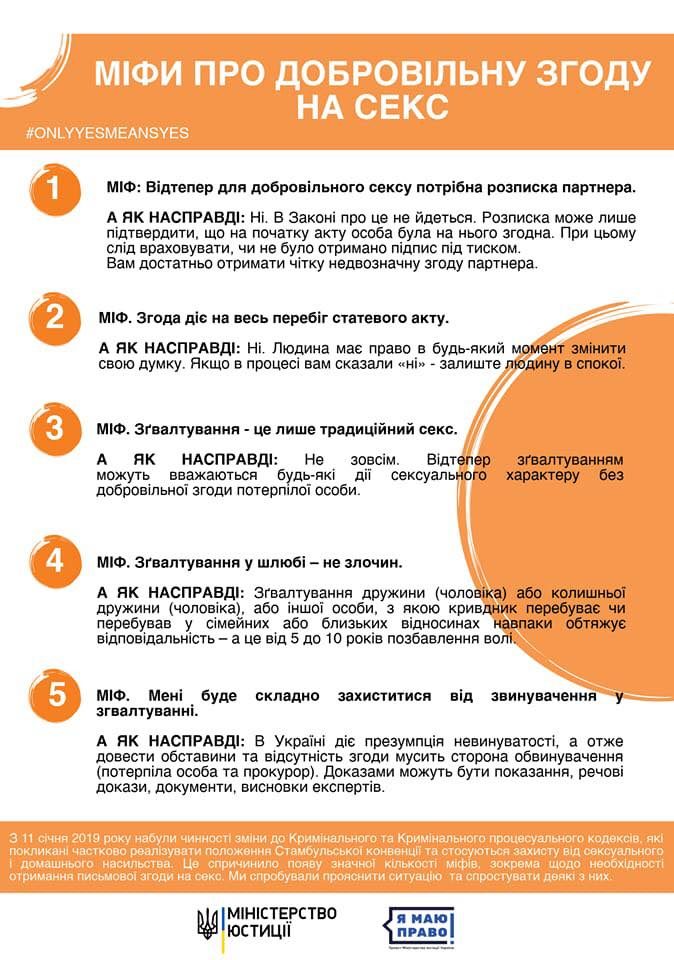
The Source: Website of the Government Commissioner for Gender Policy on Facebook
However, the most difficult thing is to take into account the attending circumstances. It is the most difficult thing, because these circumstances will be determined individually for each case, and this is absolutely logical: all cases are different. What these attending circumstances might be? For example, the situation of domestic violence. If the person experienced violence before, then that would be considered as attending circumstances.
Regarding psychological or economic dependence. This may be a threat, including the threat to make the child, loved ones or even domestic animals suffer. In addition, it may be a threat to restrict access to any desired service, actions. In the practice of civic organizations, there is assistance to people who have left temporarily uncontrolled territories of Ukraine and have taken children. There was a case, when a woman who tried to leave the occupied territory with her children in 2014, met one of the “customs officers” of the so-called “DNR” at the “checkpoint” who gave her an ultimatum, “First you have to go with me, to do your ‘job'”. That is, according to the “understanding” of the old CC, in fact, she voluntarily agreed. But today we understand that there was no voluntariness in her actions because it was the only way, the only opportunity to leave the territory. It is necessary to pay attention to this, this should be explained to investigators, prosecutors and judges, so that such things were carefully considered”, the human rights defender explained in detail.
“To collect evidence and prove each case is not of less importance. That is, in case of receiving a complaint about rape, it is compulsory to carry out all the necessary investigative actions, collect evidence, and then to start litigations. The presumption of innocence has not been canceled, just as the responsibility for giving evidence known to be false has not been canceled, too. So all these “thrills” that every statement can now be immediately regarded as a real rape is only a manipulation of criminal procedural rules.
It is also worth noting that all these changes are supportive for the victims. The expansion of the interpretation of, let’s say, coercion, voluntariness is based on existing practice, it comes from the real problems met by victims of sexual violence, both in Ukraine and abroad”, said Kateryna Levchenko.
How to explain the inadequate reaction online in some cases?

“Jokes”, strange irony and sarcasm in social networks – all of these, given the importance and seriousness of the topic, were at least strange. According to lawyer Yehor Shtokalov, such behavior of some users may indicate both lack of explanatory work and distrust of judicial and law enforcement systems.
“In my opinion, such an ambiguous reaction may indicate:
- a low level of users’ legal awareness and a lack of understanding of the causes and consequences of legislative changes;
- insufficient explanatory work on the content of legislative changes;
- sharing of myths in social networks;
- total mistrust of the judicial and law enforcement system
In addition, such a male reaction shows that they are scared of unsubstantiated accusations and blackmail by women. At the same time, it is worth emphasizing once again that the analyzed changes are not only for men”, the lawyer shared with DUMKA.

But the psychologist Oksana Palun suggests that the reason for such behavior of some users is the lack of sexual education, the lack of those who can talk about sex. Or, which is also likely – “jokers” consciously or unconsciously identify themselves as the accused.
“Indeed, it is very sad to observe such a reaction of society to problems that are in fact now quite painful. I see two reasons for this reaction. Firstly, in our society it is not a common thing to talk about sex: it is shameful and funny. Parents skip this topic with children, children do not know whom to ask. Few people know how to react to such a topic, and therefore we have such a teenage reaction.
Secondly, someone puts himself in the place of the accused. Why this is happening is another matter, but there are people who do not really think over how and who with to get involved in sexual relationships, and now they have to change something. But how – it is not clear”, the psychologist shared with DUMKA.
Manipulation and blackmail: is there anything for men to be scared?

Another wave of discussion of new changes is the fear of men, saying now, for any sexual intercourse, it is possible to get indisputable allegations of rape. What do the experts think about this? According to the lawyer Dmytro Bohuslavskyi, manipulation is really possible, but it is not right to focus on men alone. Especially since the new rules refer to a “person”.
“Manipulation is certainly possible, but note that the objective parts of the “sexual” articles of the Criminal Code refer not to a man or a woman, but to a” person”. Until 2002, a woman could not be the perpetrator of rape by the definition. It was in 2002 that the relevant changes were made in the Criminal Code”, says Bohuslavskyi.
A lawyer Ehor Shtokalov also proved the possibility of manipulation. However, according to the expert, there are a number of restraining levers. In particular, punishment for false testimony, the presumption of innocence and the need to prove the fact of rape and the lack of voluntary consent.
“Possible manipulations and blackmail are really a risk, given that after a quarrel with one of the partners or a spouse, there can be a design to create pressure by initiating a criminal proceeding. However, the deterrent levers against such actions are (1) criminal liability for giving evidence known to be false, (2) the need to prove the fact of violence or rape and the fact of the absence of voluntary consent, (3) the existence of the principle of presumption of innocence. The “fabrication of a case”, which will be based solely on the applicant’s false statements, is impossible since for the purpose of proving the guilt in this category of cases it is necessary to conduct a number of forensic examinations.
Kateryna Levchenko also says that there will be manipulations, emphasizing the protective elements that should save an innocent person. But at the same time, the human rights activist adds those who talk about manipulation often forget that all the time they manipulated.. victims.
“Without a doubt, there will be the manipulation. If there is a disputable matter, as a rule, there are always manipulations around it. Therefore, to declare that “there will be no manipulation” means to lie. There are always people who cannot live without blackmail and something like that. And here it is all about the competence of the employees of criminal justice, the presumption of innocence, responsibility for knowingly false information and protective elements.
But those who talk a lot about manipulation, for some reason, forget that all the time they manipulated victims, accusing not the perpetrator, but them. This opinion is still widespread in society. As far as I remember, in 2016 about 1050 complaints about rape were filed among which only about 50 were given court sentences. That is, only every 20 cases found completion in court. And about 95% just got lost somewhere on the way between a complaint and a court sentence. Including the fact that the reports were taken away, the pressure was put on the victims, there was no chance to prove these cases, and there were cases of criticizing women”, summed up Kateryna Levchenko.
Text by Dmytro Zhuravel