

Artificial Christmas trees do not compete with living trees that were growing in the fresh air just yesterday. Although the forests are strenuously guarded these days, and a “green” poacher, who is caught red-handed, will pay a considerable fine, the Christmas tree markets offer goods for every taste and every wallet. DUMKA decided to find out how “green beauties” enter the spontaneous markets, who bring them there and how those, who should do it, fight forest poaching.
Sale of Christmas trees is now a normal business. Trees are grown for this purpose. And this green business, like that of Janus, has two “faces”: the official path from the forest to the sales outlet and unofficial one with the use of “grey” schemes. The sales outlet are also legal and spontaneous.
“Green” poachers
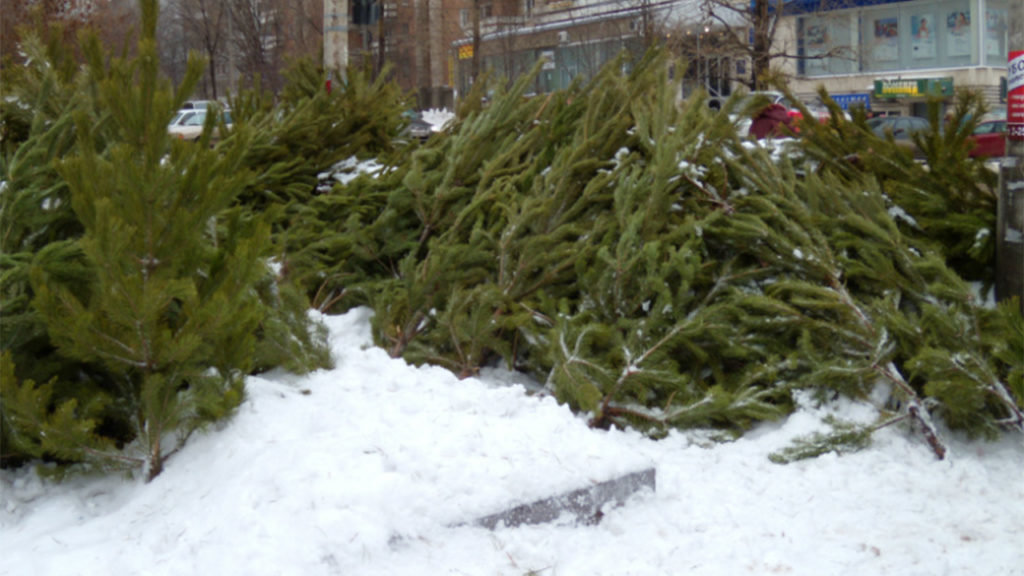
Though it is difficult to say that the number of trees, cut by poachers, is horrible, the firs are cut and chopped for sale. It happens that the schemes involve those, who must protect the firs. Last year in Ivano-Frankivsk, law enforcement officers caught four foresters, who, having received 15 thousand UAH of bribes for “permission” to cut and export firs, sold a lot of Christmas trees. The chief lumberman of one of the district forests and forest masters of several forestries were engaged in this. In addition to money, perpetrators were seized counterfeit self-adhesive labels, whose numbers were not found in the Unified System of Electronic Accounting of Wood. Under this scheme, men managed to sell nearly 400 trees, causing losses of at least 150 thousand UAH.
Usually, the trees, cut down in such a way, get to spontaneous Christmas tree markets. In Odesa, one of them is at the Novyi Rynok. A small pine costs 250 UAH, and trees for 2 meters hit a thousand. Sellers say that they brought them from Volyn, and there are neither tags on them, nor the sellers have documents. There are similar spontaneous green markets in other parts of the city.
But every forester claims that everything is all right with them ‒ raider brigades in a reinforced composition, along with police and environmental inspectors, systematically bypass forest spots. Poachers are not found: they say, they are inspired by a large fine.
For example, forest enterprises of Zhytomyr region officially sell near forestries, farms, at recreational spots, markets in cities and towns. In the Regional Forestry and Hunting management claim that this year can realize half a million trees, despite the fact that in previous years they sold no more than 50,000 trees. The price depends on the height ‒ ranges from 45 to 200 UAH and is almost the same in all regions of Ukraine, where the trees are grown. The average cost, foresters say, 60-70 UAH. An interesting option, which they offer in recent years to their customers, is Christmas trees in pots, which in the spring can then be planted in the yard.
Eco-friendly commerce
Plantation cultivation of Christmas products, according to Yurii Marchuk, the chairman of the Society of Foresters, is a normal business without harming nature. On average, about one million Christmas trees are harvested annually in our country. These are Christmas trees, pines and firs. To grow this amount of material, you need 300-400 hectares of land, the forester explains. Since the tree is growing for 3-4 years to reach commercial status, it is necessary to have 4 fields of crop rotation in order to have a constant turn.
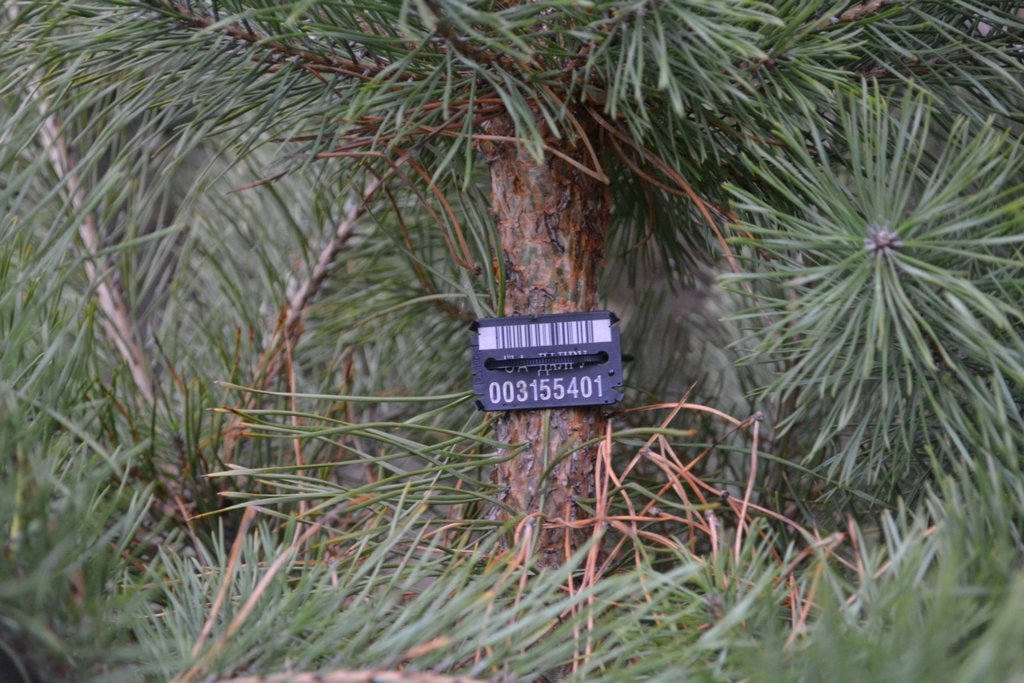
Today, there are a number of enterprises that have already organized the cultivation of Christmas trees exclusively on a commercial basis. Each such tree, Yurii Marchuk says, has its own electronic address, which allows you to make sure whether it is legal or not. “But the most important thing is that this tree is environmentally friendly. If you put it in your home, be sure that it does not contain various chemical elements that can harm you and your family”.
The illegal cut of coniferous trees, if we compare it with the official one, in this period is, in fact, very meagre, the director of the Kyiv Ecological and Cultural Center Volodymyr Boreiko also assured DUMKA. The ecologist is convinced that it is legal cutting of trees, pines and firs that have been turned into a business detrimental to both nature and the health of people. He recalls that our country already has low forest cover, so trees should be protected, not cut down, so that they would stay for a week or two in an apartment or a house, and then find themselves at a landfill.
Are “invisible” poachers working in forests?
In the Sumy Regional Department of Forestry and Hunting, it is said that at the New Year Eve period, forests are patrolled in a reinforced mode. To do this, 76 raider brigades were created, which included about 250 people, who have already conducted nearly a hundred raids. According to the deputy head of the Forestry Department, Oleksandr Banya, “violators of the forest legislation have not been yet identified”. I wonder how green trees appear on spontaneous markets if poachers are not identified?
By the way, last year in the New Year’s Eve in Sumy there were already 16 cases of coniferous trees cutting down. This is absolutely 1,394 UAH of administrative fines and 5,624 UAH damage caused to the forest (the cut trees themselves were valued so), therefore, in total 7,018 UAH were reimbursed.
In Transcarpathia, as was reported to DUMKA in the Regional Forestry and Hunting Management, foresters raised almost 23,000 fir, spruce and pine trees on special New Year’s plantations covering an area of over 23 hectares. They assured us that the Christmas trees are now intensively being watched. “Since the beginning of December, 55 raider brigades have been formed, coniferous plantations are guarded round the clock, they are on duty on the highways,” told the press secretary of the department, Yuliya Davydova. “It is now that we continue the operation ‘Save the Tree’, which is conducted by forest enterprises annually, in order to comply with the standards and limits of Christmas tree harvesting, raider inspections to identify illegal logging and transportation of Christmas trees, as well as monitoring compliance with trade rules, the legality of the sale and the acquisition of Christmas trees in the settlements of the region”.
By this time, almost 70 raids have already taken place. Just as in the Sumy region, they haven’t found a single violator. According to Yuliya Davydova, now few people without permission risk cutting down trees because of fear of a large fine. So, for a cutdown tree, you can pay from 255 to 510 UAH, plus the cost of the tree itself, which is calculated depending on the diameter of the trunk. The size of the fines depends on where exactly the poachers managed to cut the tree: in the operational forest, protected, or forest of the natural reserve fund. But last year in Transcarpathia they caught as many as… 18 violators, who cut one tree at a time! Poachers had to pay a 1,530 UAH fine and compensate 7,186 UAH for damages, caused to the state.
In the Kyiv region too, poachers walk different paths than raider brigades. As DUMKA was told by a leading specialist of the technical policy and labour protection department of the Kyiv region and in the city of Kyiv, the Forest and Hunting Department, Lyudmyla Shramkova, last year during the New Year and Christmas holidays these teams discovered as many as 40 felled trees, and 2,465 UAH fines were imposed (only 2,380 UAH were paid). The damage caused to forests (in fact, the cost of felled trees) was valued at 15,970 UAH, 11,180 UAH were repaid. This year, two people with axes were caught by forest guards (and there are 70 raider brigades of 4-5 people are working in the region), each of whom fell a tree. They have already paid for this 1,076 UAH.
There are 16 forest farms under the administration, and each of them is growing pine and fir trees for sale on specially designated plantations; they are planting nearly 80,000 coniferous seedlings annually on 16 hectares. Now, the expert notes, they offer 12-15 thousand for sale, if necessary, they can increase the volume to 32 thousand, but hardly anyone will need it: last year ‒ on their own trading floors in forest areas (addresses and prices are on the site) ‒ they sold 7,800 pieces, having received for them 640,000 UAH. Usually, they work with wholesalers, although they can sell one tree also. But they do not have their own outlets in Kyiv. “We earn little money for our pines and Christmas trees, but this is the budget’s filling, all taxes are paid from them,” Lyudmyla Shramkova says, “and we guarantee that they are environmentally friendly”.
By the way, lately, trees have begun to be grown for sale… in villages. Entrepreneurial people organized a fir plantation right in their own gardens. They buy 2-year-old saplings at the forest farm, and when after 2-3 years they grow to a commercial type, they take a certificate from the village council that they own their trees, cut them down and sell them. They say that 600 trees grow perfectly on 40 acres, and the seedlings actually cost a penny.
“Madam, do you want a fir or me?!”
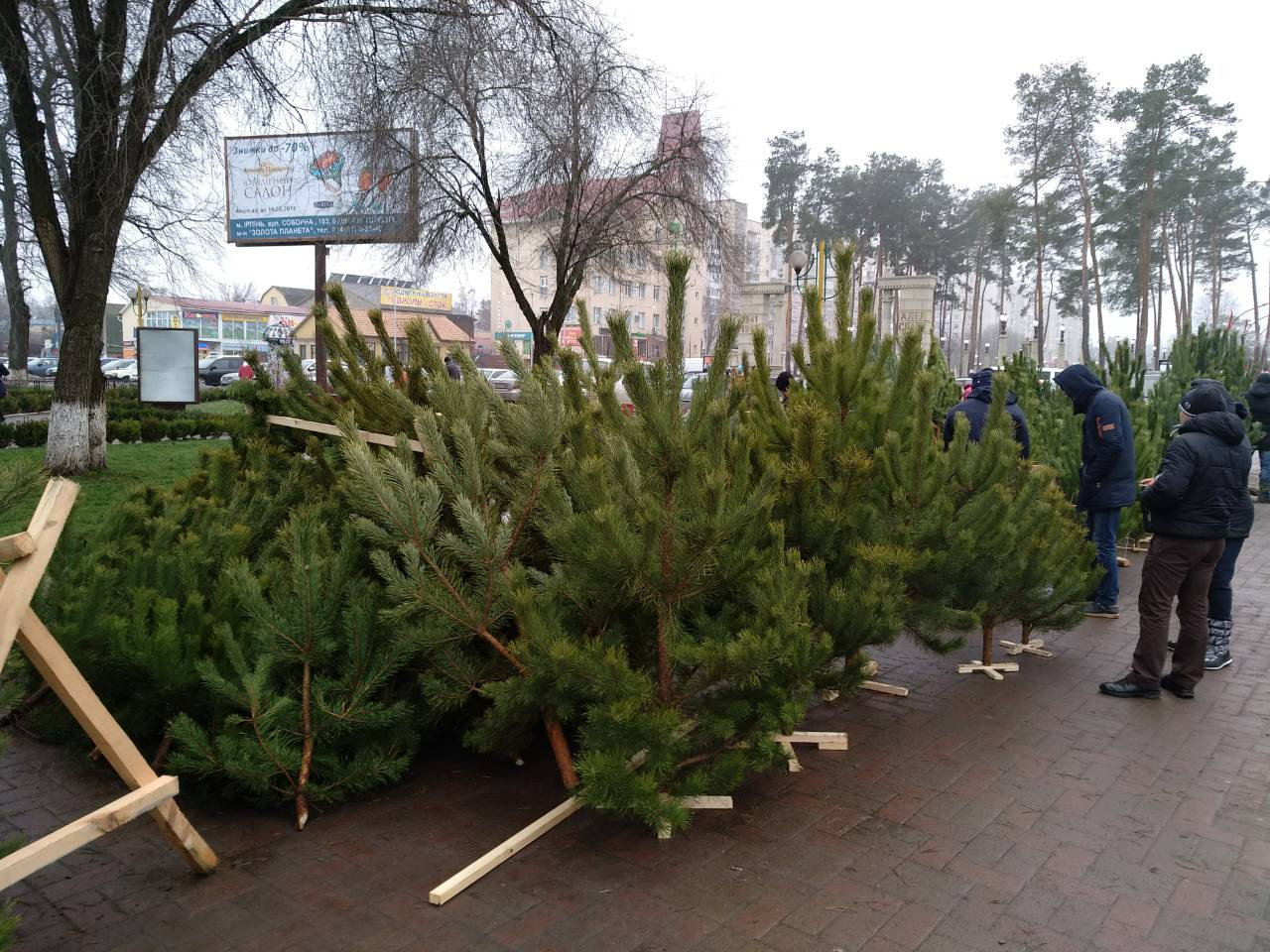
And no matter what the foresters say, people sell coniferous trees everywhere. Agricultural Fair on one of the settlement blocks of Kyiv. A minivan snuggled up to one side, and luxurious firs more than 2 m high snuggle up to it. “How much are they and where are they from?”, I ask. The seller is laconic: 900 UAH, from Transcarpathia. For made from branches asked from 50 to 250 UAH. I do not know where and how he acquired them, but I hadn’t seen any tags on the trees. The only evidence that the trees came from the Carpathians is the specific Hutsul accent of a guy.
Another spot ‒ at the railway station “Borschagivka”. Usually, the sale started exactly on St. Nicholas Day. But this year, trees appeared along the bridge a week earlier ‒ they were brought here by suburban electric trains. Namely, on December 19th, at the exit from the underpass at the stop of the high-speed tram, a glade was stuck around the vans and cars with the European registration with trailers.
Among the sellers are mostly strong middle-aged men. “Where are you guys from?”, I am interested. “The firs are from Transcarpathia, or does the lady wants us?!”, smiles the one who is standing closer, while the others openly laugh. I ask the price of their “goods”. For a luxurious fir with a height of no more than 2 meters, they asked 600 UAH, a meter-tall pine tree with a crooked trunk and yellowish needles — a hundred, and collected from branches of trees on round pedestals — 200 for each one.
Another similar spot is near the Dorogozhychi metro station. There are coniferous trees scattered right on the sidewalk. Prices start at 200 UAH. The sellers claim that the product is quite legal (there are no tags on the trunks) and they say that they brought trees from Chernihiv region and have four sale spots in general: another one nearby and two near the Lukyanivska metro station. But in the Kyiv City Council, they are determined to fight decisively (at least in words) against all illegal traders. They say that all of them will be given instructions, after that the sale spots themselves will be dismantled, and the penalty for violation for an individual is 800 UAH. Kyiv officials do not understand why running the risk if the main New Year attribute can be legally realized at one of the 190 spots that operate in the capital.
However, at the official level, it is argued that poachers are not a problem, because there are actually few of them. For example, this year, in the press service of the State Forest Agency of Ukraine, more than 3,5 thousand raids were carried out in subordinate forest farms (and this is 73% of the forest fund of the country), while over 400 trees were cut down and 235 administrative protocols were compiled. Almost 13,000 UAH of fines were imposed on violators, of which more than 10,000 have been already paid. But the felled trees themselves are valued at almost 74,000 UAH, of which 32,000 were refunded.
And taking into account a large number of spontaneous green markets, you come to the conclusion that they either do not catch very well or even the scheme has been debugged, according to which the needles fall on such trades. One of the schemes, according to witnesses, looks like this: most of the trees, which end up in spontaneous markets, are stolen. “Businessmen” know in which village they have to drive “KamAZ” or a minivan ‒ and the people themselves actually drag the trees, chopped down in the near forest, for pennies.
“If we buy a fir that does not have an electronic marking, does not have proper accounting in the system, then we are so much at risk,” the head of the Society of Foresters explains. “Where is this problem from? This is precisely the problem of self-seeding forests, which appeared on abandoned agricultural units, which are particularly numerous in Polissya. According to various estimates, such forests have several hundreds of thousands of hectares, and there are many self-propelled pine trees aged from 4 t o 10 years. It is there that it is harvested, imported to railway stations, and already near such stations the spontaneous markets are formed”.
According to Andrii Plyga, the coordinator of the WWF volunteers in Ukraine, the violations begin with the very harvesting of supposedly official Christmas trees. Any entrepreneur can buy Christmas trees for sale in the forest farm. The forest farm issues a purchase document and the origin of the trees from this forest farm and the tags, cling them to the felled trees in order to exclude further machinations. But in fact, most often tags are issued simply separately from the trees. Therefore, having agreed for the appropriate amount, entrepreneurs can buy a greater number of trees in the forest farm than indicated in the documents and issued Christmas trees’ “passports”. It is unlikely that someone will count them in the back of the KamAZ. Entrepreneurs, the volunteer says, then put up a tree without tags for sale, showing them to customers or the police only on request. Sometimes there are even tags on the trees, but they are not fixed around the trunk, but simply hanging on the branches: the buyer picks up the tree, and the seller picks up a tag, to hang it on a branch of another tree. There may still be fake tags themselves. Therefore, the electronic accounting system is unlikely to guarantee the legal implementation of the New Year trees.
However, the foresters convince that the New Year-Christmas sale of firs if it is conducted according to all the rules, in fact, does not harm the forest. Like, there can be more harm than joy from an artificial tree. But it is painful to watch when hundreds of yesterday’s green beauties are thrown into the landfills throughout January, turning into trash overnight. Maybe if you really want a coniferous aroma in the house, you should limit yourself to just a few branches? In any case, I have been doing this for about ten years.
Text by Larysa Vyshynska