

It’s getting more and more dangerous to walk on our land. Until recently peaceful Ukraine last year entered the top five countries in terms of the number of victims from mine explosions, along with Afghanistan and Syria. Adults and children are dying. Almost half of a century will be needed to neutralize the deadly objects if we provide systematic work and sane legislation. Meanwhile, the war continues.
Humanitarian and operational
It’s scary not only because of the explosions and casualties. But also because the mine issue connected to the deaths and injuries of the military and civilians gets stuck in corruption and cynical attempts to earn millions. On the fifth year of the war, we don’t have appropriate legislation on mine action. Why is there no agreement on the issue that should be tackled immediately? Experts argue that procrastination is just due to the fact that officials have an opportunity to steal money because the process of demining is too expensive.
Reference
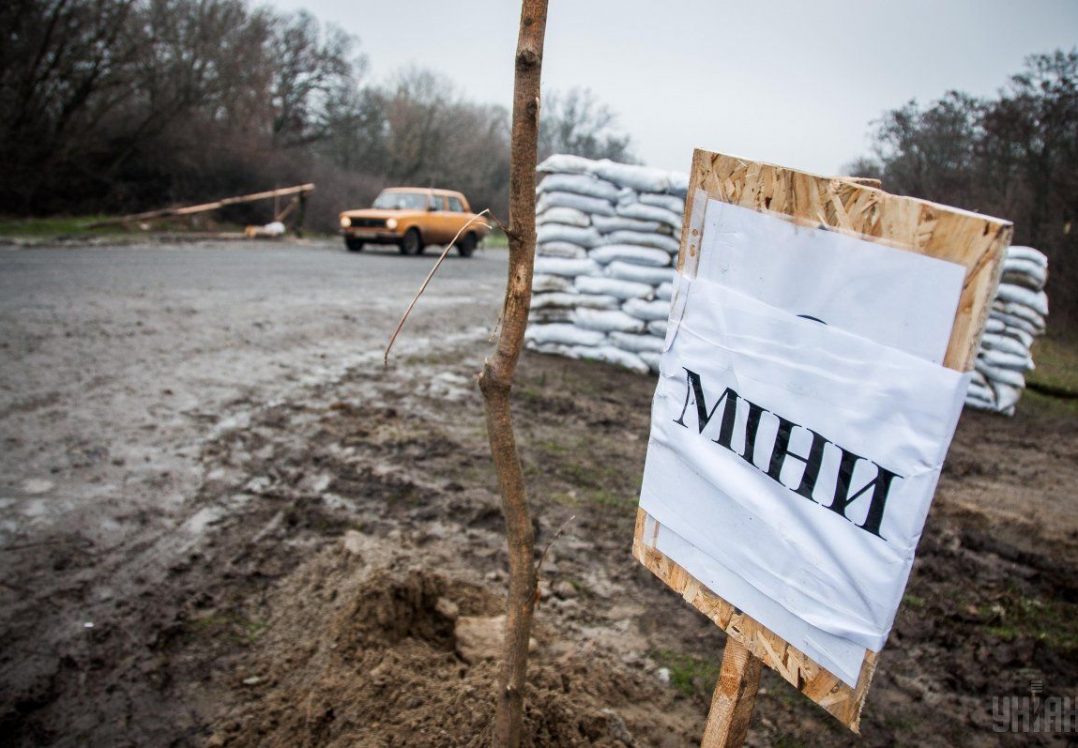
About 40 countries have mine contamination. According to UN estimates, for one year of the war, there are 10 years of demining. Calculations of experts say 10 years of work cost 500 – 600 million dollars. In the east of Ukraine, about 7 thousand square kilometers of the territory were mined (almost the area of the Chernivtsi region) of the controlled territory and roughly twice as large (the area of the Ternopil region) is contamination of the temporarily uncontrolled one. Only a few percents of the territories are cleared. The map of sites contaminated with explosive items in the Donetsk and Luhansk regions and more detailed statistics is on the official website of the Ministry of Defense of Ukraine.
To effectively solve the problem, we need a law on mine action, where humanitarian demining must be recorded, the main goal of which is the restoration of the territorial integrity of Ukraine, the reintegration of Donbas into the economy of the state, the creation of favorable conditions for life. That means that the territories should be cleared and should be suitable for agriculture, construction works. Foreign companies that are already present in the east are waiting for the legislation and they cannot fully carry out their demining duties.
Experts propose to separate the functions. The Ministry of Defense and the State Emergency Service of Ukraine should be engaged in operational demining at the expense of the state budget. But the humanitarian demining of the territories that belong to the communities should be given to specialized companies. In the whole world, they do it, the UN keeps their register. Humanitarian mine clearance should occur through the involvement of donor funds, including the OSCE, the UN, private foundations. Separation of functions implies transparency and, it seems to allow performing the work quickly, efficiently and effectively.
Volodymyr Petrachenkov, the Director of the specialized demining company “Transimpex” JSC, explained to DUMKA: “Now, no structure that’s engaged in demining can perform the whole complex of works. The reason is simple – by and large, there is no quality control, the inspection of the cleared territories”.
Who suffers from mines?
Those, who know not from the news about the numerous tragedies in the Donbas confirm the gravity of the issue. The exact statistics of mines’ victims and other explosive remnants of war since the beginning of the conflict in the east is unlikely to be revealed. However, a few months ago, the media mentioned the number of about 1,600 people.
Tetyana Koshel, coordinator of the humanitarian mission “Proliska” in Mayorsk, said to DUMKA: “A lot of such cases are happening. Especially in the cold season. People don’t have the money to buy fuel, and they go to chop the firewood. Local people, who graze livestock, also become victims of landmines. The areas are very contaminated with mines. Many weapons were thrown here. Now the situation has changed a little. In 2014-2015 the problem was very acute. No one made a map of the mined areas. Some went, others came, and many military men were blown up on their stretches. Children suffer. They are messing around, not every adult can control them. And adults are irresponsible. How can someone bring an explosive object when the children are at home?”
The Danish Refugee Council carried out a project on humanitarian mine clearance and mine risk. Within its framework in December 2015, Tetyana Koshel received training, traveled with fellow volunteers to Svyatogorsk for training.
Ms. Koshel continued: “Then we went to labor collectives on the line of demarcation. Including mothers with small children, retired people, we informed them about mine danger. We also worked with children, showed them in game form what could happen, why we cannot touch unknown objects. A group of the Danish Refugee Council performed in all schools and kindergartens on the line of demarcation. The UNICEF children’s fund is also operating”.
Oleksandr Dichek, the President of the International Anti-Terrorist Unity, said: “Almost every week, civilians are being blown up. During this time, more than 200 children were killed. This is a terrible statistics, and we must do everything to bring peace to Donbas. Children walk in the woods, in the glades, and everything happens because of their ignorance and inability to handle such objects”.
Reference
Mine action consists of five items: a) mine risk education; b) humanitarian mine clearance, that is, the reconnaissance of mines and ERW (explosive remnants of war), mapping, marking and clearance; c) assistance to victims, including rehabilitation; d) destruction of ammunition; e) advocacy against the use of antipersonnel landmines. (From the website of the Ministry of Defense of Ukraine)
Whose draft law is better?
The mine clearance system is a deeply corrupted sphere, and the adoption of the legislative base is delayed artificially since it presupposes the existence of international control. Now the demining is handled by the State Emergency Service of Ukraine, and in the opinion of the co-chairman of the NGO “Prava Sprava”, Dmytro Sniegiryov, this Service is practically a monopolist in this field.
Mr. Sniegiryov explained to DUMKA: “Mine clearance is an expensive pleasure. Sometimes, the same sites are cleared several times. It is very difficult to verify the fact of mine clearance. Farmland is located almost on the line of demarcation, in the so-called gray zone, and the farmer in order to use his land must obtain an act on demining of the territory. They actually twist his arms, demand a bribe for clearance. The farmer becomes a hostage to imposed conditions. Therefore, the presence of international non-governmental organizations in demining of these territories is more than feasible”.
There were plenty of draft laws on mine action in Ukraine. On the parliamentary website, you can get acquainted only with governmental one, dated 2016 year. In particular, №5189-1, initiated by the Prime Minister Volodymyr Groysman and last year withdrew from consideration, and №4137, initiated by the former head of the Cabinet Arsenii Yatsenyuk, which was recalled the year before last. The International Anti-Terrorist Unity also has proposed its draft law.
Oleksandr Dichek said: “The working group of the Verkhovna Rada Committee on National Security and Defense Affairs and representatives of our organization has done everything to make the bill look complete and effective. Now the ball is on the side of the deputies’ field in Verkhovna Rada. The law should be adopted as soon as possible so that we could demonstrate international partners that Ukraine is doing its best to start the work on humanitarian demining, which is the part of the Mine Action Act”.
According to Mr. Dichek, the national mine action body should be independent and consist of representatives of various organizations. This is evidenced by the experience of countries with mine problems – Croatia, Bosnia and Herzegovina, Azerbaijan, where humanitarian demining continues for 16-18 years. There is a national independent structure, which includes representatives of various ministries and the public. These countries received several hundred million dollars of aid from the relevant companies, donors, foundations, the OSCE, the UN. And in states, where the national mine action body is the Ministry of Defense (Armenia, Libya, Iraq), international aid is sparse, only 1-3 million dollars.
Oleksandr Dichek continued: “There are no funds in the budget, so we propose that specialized companies, not the Defense Ministry and the MEU (Ministry of Emergencies of Ukraine), deal with humanitarian demining. These state structures should carry out operative demining for budgetary funds. For example, in charge of humanitarian one, should be companies like “Ukroboronservis”, “Transimpex”, which have licenses, certificates, permits. And, most importantly, a colossal experience not only in our country but also abroad. Even now, when demining is going on in military warehouses, it is necessary to take the experienced sappers from the front lines and send them to the territory where the fires occurred and the explosions occurred. These structures could do this work without taking the sappers from the front line”.
Yurii Grymchak said to DUMKA: “My experience shows that if there are several alternative draft laws, then usually none of them will pass. But this is a very urgent problem, and it must be understood that after the liberation of the occupied territories, the problem of mine clearance will arise in its full scale. Mines are uncontrollable. There are facilities where repairmen refuse to go because it is dangerous there, and it takes several years to clear everything. The same situation with minefields – there are no maps, and there will be a lot of work to do”.
MPs are working
Despite summer holidays, the working group on the development of the draft law on mine action meets in the Verkhovna Rada Committee. As MP Iryna Friz reported on her Facebook page, representatives of ministries and departments should submit written proposals so that on the eve of the fall session of the Parliament the author’s team will register the bill for consideration in the Verkhovna Rada. Representatives of the US Embassy, the NATO Representation in Ukraine, OSCE, officials of the MEU and several ministries participated in the discussion of the document.
According to Secretary of the Committee Ivan Vinnyk, mine action activities are divided into three types: the work of the Ministry of Defense; operational area related to the actions of the MEU, when, for example, it is a question of explosive devices from the Second World War; and the humanitarian action – the elimination of the consequences of the current war.
Ivan Vinnyk told to DUMKA:“The draft law focuses mainly on humanitarian demining activities. In this direction, it’s planned to allocate funds from the state budget, as well as to attract funds from international interstate structures. We introduce competitive, impartial procedures to identify problems, access to information on the area that requires humanitarian mine clearance. We introduce the central executive authority that will manage this activity, as well as the regulating organ, which will deal with licensing. We introduce competitive procedures for selecting tender winners, the issue of impartial control”.
Mr. Vinnyk hopes to adopt the bill until the new year. However, Volodymyr Petrachenkov, who has been involved in anti-mine activities for more than 40 years, criticizes the document:
“The bill is corrupt. The inspection, which was dismissed by the state, comes from the nowhere. Its role should be carried out by the mine action center, hired on a competitive basis by core companies and they conduct so-called external quality control. And the inspection means extra officials. Where did the central executive authority come from? Also, there are a lot of officials, who do not answer for anything. The so-called national mine action body has emerged as a separate commission. Again, officials.
Separately, the accreditation body. For some reason they want it to become Kamenets-Podilsky demining center (the Mine Action Center of the Operational Support of the Armed Forces — Author’s note). Nonsense too. How will it look like? Well-known companies will come with money, but will they be accredited by an official? This should be handled by the operational body. They also try to introduce licensing. We are fighting for the abolition of licenses, and here again licensing conditions. Money for this bill won’t be given”.
Volodymyr Petrachenkov said that a simple, cost-effective solution was offered. The role of the national body should be put on the State Commission on issues of technological and environmental safety and emergency situations, adding the words “and mine action”. It is enough to add the head of the mine center. The Prime Minister leads the Commission, and he signs all the documents. He does not need money, state officials, cars for that. And the operational body is a subject of public law, a legal entity created by the Cabinet. In total only one person is responsible – the head of the mine action center. If he isn’t, he will be replaced.
Petrachenkov said: “The military should be left with their own affairs and do not pry into mine clearance, no donor will give money to the army. The UN documents clearly state that they will not deal with military organizations”.
Vacancies for local
The bill is being finalized by the working group, so changes are possible. Yurii Grymchak also has his own view on the proposed projects: “The Cabinet Ministers are more professional. When we participated in their development, they relied on the experience of the whole world, including Croatia, on the EU demining programs. The public understands all the nuances in this case”.
Experts also note the specific difficulties of demining of certain Ukrainian territories. Among them is the used by the enemy expired ammunition. In addition, unlike Ukraine, Russia is not a signatory state to the Ottawa Convention on the use and destruction of anti-personnel landmines, which it uses extensively in Donbas.
Experts also don’t forget about the social aspects related to mine clearance. Not only officials and businessmen can earn on the consequences of the war, but also local residents.
Oleksandr Dichek assured: “Territorial communities act as customers for humanitarian demining. Then representatives of specialized companies conduct study, training, removing social tension in the territories where our citizens live. People will see that their hands are needed, and understand that if the territory is cleared, then it will be possible to plow and sow. There are jobs in which women can participate, so the gender issue is solved as well”.
By Viktor Tsvilikhovsky