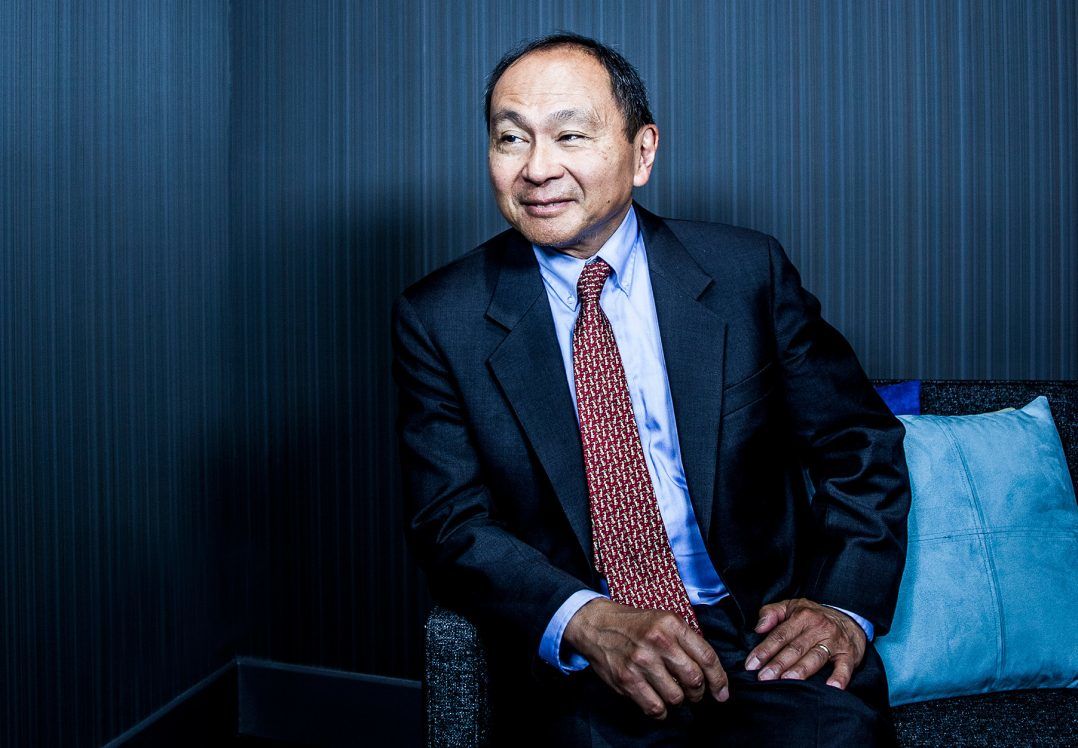


At the end of April, the Cabinet of Ministers Secretariat, the Professional Government Association, the Kyiv School of Economics and the Center for Democracy, Development and the Rule of Law at Stanford University signed a Memorandum of Cooperation in the framework of the reform of the state administration system in Ukraine. The project “Civil Service Feedback Cycle” provides for specialists from Stanford University to conduct a basic survey of public service in Ukraine in the form of interviewing various categories of officials on several key parameters and working out recommendations for improving the work of the state apparatus.
Prime Minister of Ukraine Volodymyr Groysman and Professor of the Center for Democracy, Development and Rule of Law at Stanford University, famous American philosopher, political economist and publicist Francis Fukuyama took part in the ceremony of signing the memorandum. “The close cooperation between my institution and the Ukrainian Government, I hope, will help Ukraine to move in the right direction in providing public services and public administration,” said the author of a well-known article “The End of History and the Last Man”, who has been closely following the situation in Ukraine since the Orange Revolution, believing that it is here that the “lighthouse of hope for many other countries of Europe and the world” is located.
We bring to the attention of readers the speech of Francis Fukuyama to representatives of ministries and public organizations.
***
“The importance of the state’s ability to develop is my favorite topic.
Any modern system has three basic pillars, which must be balanced. The first is a state that has a monopoly of power in a certain territory. This power is accumulated and used by the state to protect society from internal and international threats and to introduce services: education, infrastructure, health care and the like. Traditional, patrimonial states were almost the continuation of government, when the ruler distributed goods to his relatives and friends. To have some position in society, one had to have something to do with the rulers. Unfortunately, so many states are still being built this way- your relations with one, who is in power, are important.
The modern state differs in that it is impersonal. The private and public spheres in it are very clearly separated. Public servants serve public good and public, rather than their own interests.
The second reason is the Rule of Law. It exists only when the supreme authority of the country must obey the same rules as all the others, and it is institutionalized in an independent judiciary.
We see that the state and the Rule of Law are somewhat contradictory: the first accumulates power, the second puts the limits to the power. Therefore, the third basis is very important – accountability, expressed in the form of democratic free elections, which should ensure government service to the general public, rather than the narrow interests of the elites. That is, in the modern state, there is a balance of institutions that accumulate and use power and strength, and those institutions that hold this power and force.
If the state is too powerful, and the institutions that restrain it are weak, then we get dictatorship. An effective modern state can also be an effective dictatorship, as, for example, in China – a powerful state with a very small number of restraining factors. On the other hand, if there is a higher democracy, the right, but the state is very weak, that is, there are conditions (and we see it in many countries of the world), when the state is illegitimate, as it is not able to introduce new laws, provide basic services, and in some cases disappear, as, for example, in Syria, Libya, Somalia, Afghanistan.
We like the system of checks and balances, and sometimes we forget the importance of having a powerful, impersonal modern state. In particular, from the point of view of economics. Because a high level of corruption automatically diverts resources from business, entrepreneurship. Financial flows go into the pockets of those in power, this promotes protectionism, resources are not used to support innovation, economic growth, but serve to protect the interests of those who have political ties. There are many studies that show that corruption is one of the biggest obstacles to economic development in many countries.
From a political point of view, corruption and weak governance are powerful characteristics of weak democracies. When I say this in other countries, I very often cite the example of Ukraine. After the Orange Revolution, for the first time after a long period, the prerequisites for the development of democracy appeared, but this opportunity was lost, as the state did not make sufficient efforts to build a modern, capable of providing basic services. There were no issues of reforming the bureaucratic apparatus, the civil service to ensure that the government implemented and fulfilled the promises of politicians. And we saw how Yanukovich returned to power as a result.
We like the system of containment and balances, and sometimes we forget the importance of having a powerful, impersonal modern country. In particular, from the point of view of economics. Because a high level of corruption automatically diverts resources from business, entrepreneurship. Financial flows go into the pockets of those in power, this promotes protectionism, resources are not used to support innovation, economic growth, but serve to protect the interests of those, who have political ties. There are many studies that show that corruption is one of the biggest obstacles to economic development in many countries.
Earlier I talked about the tendency towards populism and nationalism, when democratically elected leaders (for example, in Hungary and Poland) undermine the principles of law, because it interferes with their political power. This leads to high corruption of the basic institutions, and it is a very dangerous trend.
I think that the Revolution of Dignity was really, in fact, that the Ukrainians, especially the younger generation, did not want to live under such a government. I think that Europe and the European Union in their eyes had been just an impersonal, effective modern state. And it was exactly the choice that Ukraine made in 2013-2014. You should continue this.
I can tell many stories about countries, where the weak ability of the state has endangered democracy. In India, for example, there is a terrible problem with inequality, since the system of public education is not effective. In the late 1990s, studies showed that teachers were paid a salary there, but did not come to work and did not have lessons. This caused great outrage, all attacked the government, which does not provide the proper level of education, especially for the poor. Ten years later, a study was conducted again, which showed that 50% of teachers also do not go to work…
“A strong state” does not mean repressiveness, but a qualitative provision of basic public services to the society on an equal footing, including education.
Another example is Africa, where, despite the large volumes of American and French aid in the fight against terrorism, Islamic terrorist groups are very active now. One of the reasons for this is that significant financial flows go into the pockets of politicians and military generals, states are weak and do not have the basic ability to control their own territories.
Take a close example – the issue of privatization, which took place in Russia, Ukraine and other countries of the former USSR in the 1990s and had the goal of reducing the state. So, transparency and fairness of these operations were not ensured (regulatory bodies, such as the Securities Commission, were not at that time), and a class of oligarchs appeared – people, who could use asymmetric information. This is the problem of countries, in which there is no state that can guarantee equal rules of the game for all. Russia and other post-Soviet countries still have such problems.
Another example is East Asia, where the traditions of the state’s ability are long. The last two generations are the rise of Taiwan, South Korea, Japan, China. These countries already have the largest economy in the world. Why were they able to achieve economic growth so quickly? I would say that one of the reasons is that they have a long tradition of meritocratic democracy. For example, China invented the modern system a few thousand years ago, at times of unifying empires. Chinese culture rewards education, providing high-level people with high positions. This is a tradition that is being continued also by the Communist Party in China. I do not want to say that there is no corruption or protectionism in these countries, but they have a powerful tradition of a modern impersonal state that allowed them to accumulate capital and build their economy. They introduced an industrial policy, gave preferences to industries in which they wanted to see economic growth.
In other countries, where there is no such a powerful, capable meritocracy, where politicians play a decisive role in resource allocation, there are enormous problems with corruption. In East Asia, such a situation could be avoided, because there was built a bureaucracy, cared for the public interest, and not for any region, family or individual.
In today’s world, we have huge differences in economic and political outcomes. East Asia is growing so fast. And the countries of Africa have a terrible level of poverty, since in this part of the world traditionally accented on other characteristics of the state – intelligence and military. The civil capacity of the state to provide basic services in an impersonal way was not emphasized. Such a historical legacy also affected the countries of the former Russian Empire. And that’s why it’s very important to break away from this tradition. No country is doomed to its own history. I was very pleasantly surprised to see that Ukraine has such a powerful civil society that manifested itself in 2013-2014. A lot of ordinary Ukrainians seek modern institutions and are ready to take risks. This gives hope that the Soviet legacy will not permanently determine your future.
How to achieve the high state ability? The answer is quite simple. First of all, it is human capital, the intellectual ability of the people. Vocational trainings determine how successful they will be in the public service. Known for their quality, bureaucratic systems are very closely associated with educational institutions that provide new staff. Without the reform of the educational system in the UK, the curriculum was modernized and new institutions were created, such as the London School of Economics, which taught and trained bureaucrats. The Higher Civil Service Corps of Japan is being prepared by the Royal University, which later became the University of Tokyo. Education is very closely linked to the creation of state capacity and modern bureaucracy. Therefore, the participation of Ukrainian educational institutions with the help of, for example, Stanford University, is very important for creating the human capacity that underlies the state’s ability.
Social capital is also important. People in organizations are not separate, isolated persons. If they really want to serve the public interest, then they should feel their loyalty to the organization. These are the key tasks, challenges that Ukraine must constantly think about, when developing a new system of public service.
Honestly, I do not know how many more revolutions can be, and I think that if the Revolution of Dignity is not successful in this respect, it will take a very long time before the chance for reform appears again. You should take advantage of the opportunity that is now open to you. Democratic governance is not just about restraining power. This is about the democratic exercise of authority.
In my program at Stanford University, we are very much and closely working with social activists around the world. We bring them to Stanford, we train them. We like to work with them. But public activists, who live in a country that seeks to build a real democracy must make a transition from civil society to civil service, where they can more effectively put their efforts. Civil society is very important for monitoring and accountability of the government. But from the environment of civil society, it is impossible to manage the state. And if good people think that politics is too dirty, and bureaucracy is not very good, not prestigious and little-paid career, then they cannot build an effective state that is one of the important foundations of modern democracy. The Ukrainian project on reforming the civil service is one of the most important, and I wish you success. I, personally, my university, my center will do everything to help you. This is very important for us, because we have a common struggle in defense of democracy in the world. And Ukraine is at the forefront in this struggle”.
Text: Hanna Drozd