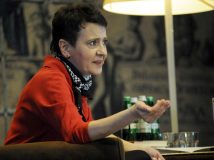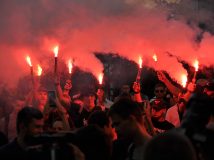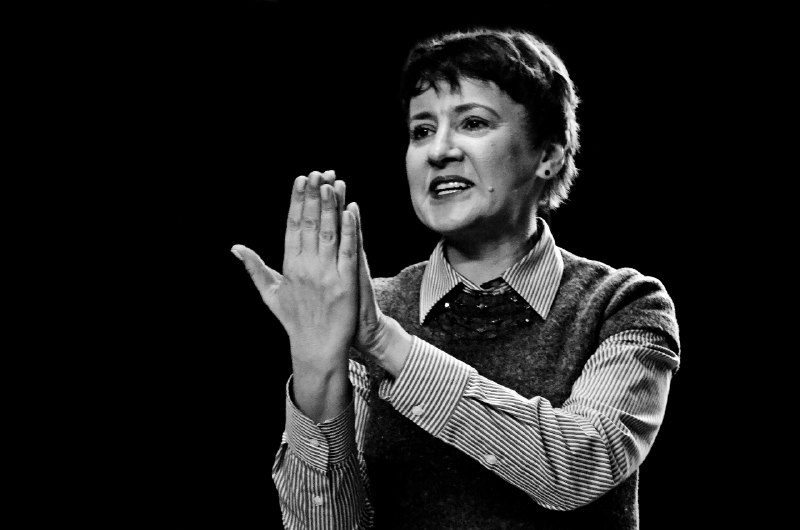


This year she received the Shevchenko Prize. However, not a literary one – she was honored for journalistic work. Nevertheless, we suggest to not get acquainted with her like with the author, but rather like with “daddy’s girl”. About childhood, youth, cultural feminism, surzhyk and struggle for independence – the way Oksana Zabuzhko herself sees it in the section “Who is…” from DUMKA.
Mother – an atypical Soviet teacher, Zabuzhko – a typical “daddy’s girl”
Today, Ms. Oksana stresses: she was lucky with her childhood since it remains the basic structure of the individual, a source of impressions about the world.
“I don’t remember it myself, but I know from my parents’ records that at the age of four I declared: I don’t want to grow up because I do not want to die! However, it hadn’t stayed in me for a long time. Once my fear of death gave way to another fear: not to have enough time to do what I want, and what I have to do in my life.”
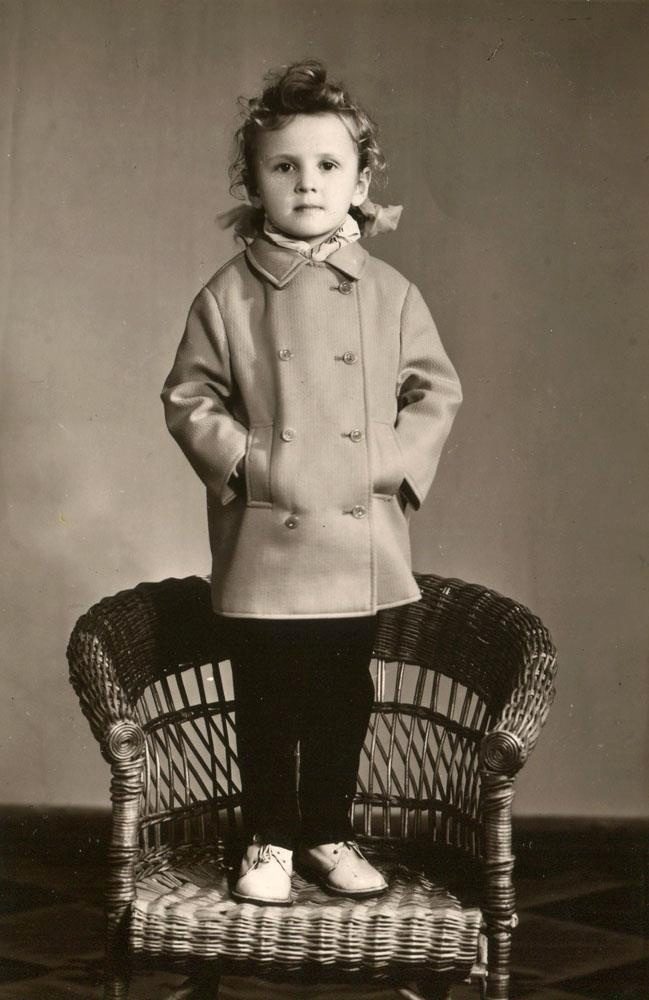
The mother of the author did not resemble the typical literature teacher of the USSR era, on the contrary: she hated the Soviet school with every fiber of her being, and she considered the dumbest segment of society… the teachers themselves.
“She is what was called a dissident-teacher. Such educators were adored by students and on the contrary disliked by bosses and colleagues. She could recognize them simply by expression of their faces: “The dumbest faces,” she said. The expression of some rigid authoritarianism, and something like self-satisfaction of the person who got the right to teach, “command the cattle”.
However, despite everything, Zabuzhko primarily considers herself “daddy’s girl”. She says that this is a syndrome not only according to numerous literary, sociological and cultural studies.
“It was Americans who conducted research and concluded that all successful women, no matter who they were – businesswomen, movie stars, writers, or artists, however, all successful women are daddy’s girls.”
The youth was not easy, the college days – gloom, only after 40 it became easier
The writer admits it herself. She said that in general it was difficult, and, in particular, her youth was also during “the darkest time of the empire, Brezhnev-Andropov-Shcherbytsky”.
“…College days – it was a complete gloom, it fell sorry for myself when I look back – it was like in prison, those “best years” had passed … But, I think, it is often difficult for a young woman. After 40 and plus, it’s getting easier and easier – you are more and more confident in yourself and you have nothing to prove to anyone. And when you’re young and pretty, a lot of energy is spent in order to make everybody to perceive you seriously.”
Although today it may seem to the vast majority that Oksana Zabuzhko always controls everything and does not worry about trivialities, it turns out that there is something that still makes the writer anxious. It is the same thing as in childhood, it is time.
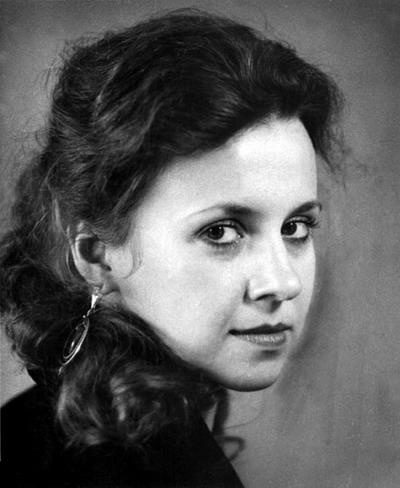
“After 50 you already understand very clearly that your time is physically limited, 20 or 30 years of active work are ahead – it just depends on how lucky you are. And you start to “optimize the load”, drop some things from the ship: I won’t do this, I will not go there, I won’t take it. You start to save time because this becomes the most valuable thing.”
She likes to be “naturel”, and her life is exactly the one she wanted
Quite unexpectedly, but in a conversation with Zabuzhko one journalist, jumping from one topic to another, had asked… haven’t you thought about any plastic interference in your own appearance.
“I’m absolutely comfortable with my face and my body. Now I even start to get rid of decorative cosmetics little by little. I like to be naturel. So, do I need these trips every six months to fix your own body? I consider it as the manifestation of a serious mental disorder.“
Instead, recalling childhood dreams, the poet confesses: in general, she is that very woman she wanted to become in childhood. Actually, the one whom she had made herself.
“By the measure of freedom that I have, yes, I am that very woman. By the way, don’t think that it was easy for me to obtain it, all these had to be won, and by the way, it lasted for many years. It wasn’t easy, and it was not, it was not boring. I’ve never lived as it was “prescribed” because “everybody lives this way.“
Men and women are different, because of this it is interesting
During one conversation the writer admits: she is terribly happy that she was born a woman. After all, women, in comparison with men, are much less and poorer described in culture. Therefore, obviously, from here the author’s love for the so-called “cultural feminism” appears: women have the same right to otherness and difference.
“‘One, two, three, four,’ don’t suite here, it isn’t arithmetic, it is algebra with differential equations. That is, let’s not measure ourselves by male standards. We are different, women and men, this very thing makes it interesting.
For this, I love the so-called “cultural feminism”, which has discovered and upholds the right of women to this distinction, this otherness, our own world. We don’t have to adjust to standards developed by men’s culture. Women are incomparably less and poorer described in culture, less studied. Thus, I think I was terribly lucky to be born a woman.“
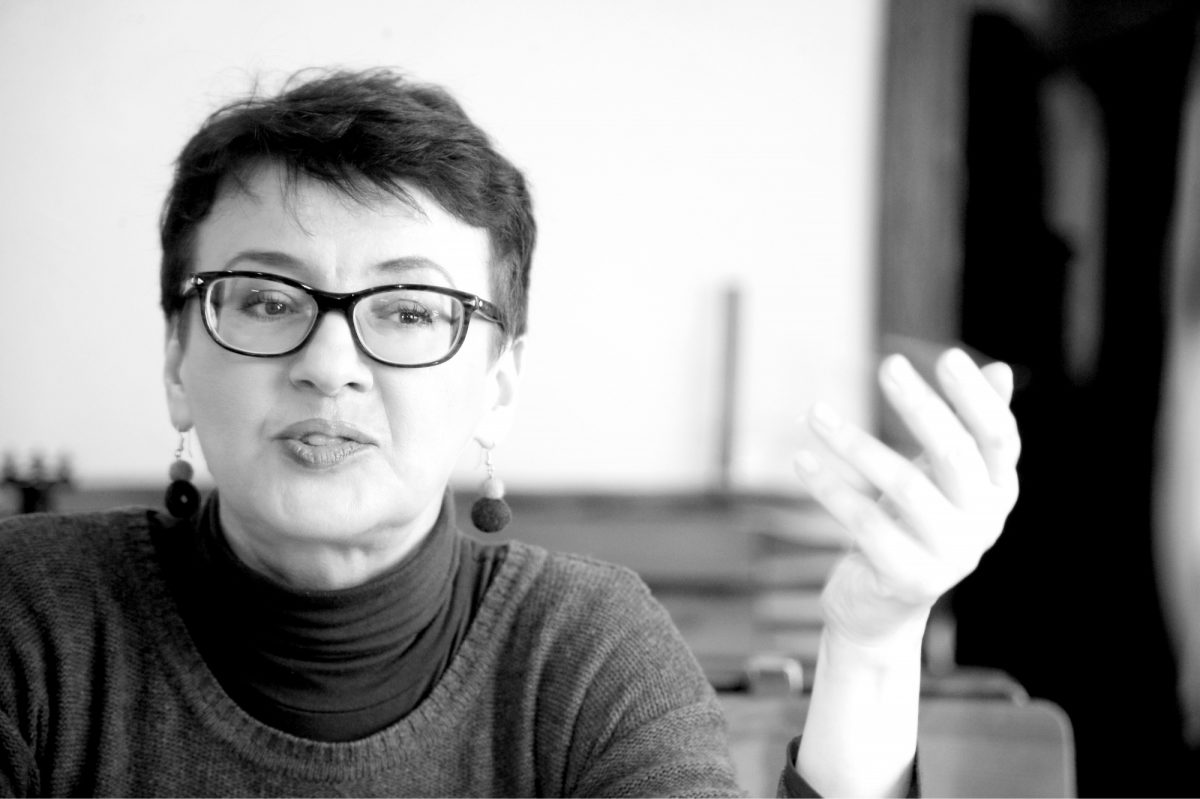
Ukraine can be characterized as surzhyk-speaking, but Russian-speaking – never
It is about the language the writer is asked about most often. Probably, sometimes even more often than about literature. Zabuzhko herself says: in her youth to hear Ukrainian in the street was, besides all, the opportunity to understand the reading circle of its carrier.
“Ukrainian-speaking youth in the 1990s – it was a marker of a certain political position. 20 years ago it was possible to immediately determine the scope of your reading by the way you speak. Today, if young people speak Ukrainian, it doesn’t mean that they read Khvylovy, Zabuzhko or somebody else. Back then a pressure shift commenced due to the spread of the Ukrainian language.
However, Zabuzhko emphasizes: our country may be called surzhyk-speaking (surzhyk – a mixture of Russian and Ukrainian languages, read more – translator’s note), but it will never be Russian, even by its very definition.
“Ukraine is surzhyk-speaking. It will never be purely Russian. By its definition. Experts should immediately explain it to different kinds of Kolesnichenkos, so that they could calm down. It is due to the articulation device that will never allow Ukrainians to speak Russian only.“
“Complex and interesting times in which it is very uncomfortable to live”
These are the times, which, according to Zabuzhko, will be extremely interesting to read about for our grandchildren and great-grandchildren in some theoretical 30 years. And the times when it had become clear: the complex of inferiority is a fiction, we are not so small, we are independent.
“According to my observations, we have long been relying on anybody. Somehow, we became convinced in 2014 that we will be able to manage ourselves on our own – and, by the way, it is a big factor of political maturity. Before the war Ukrainians had a complex of not just inferiority, but, indeed, of external paternalism – the child’s hope for some “grown up uncle.”
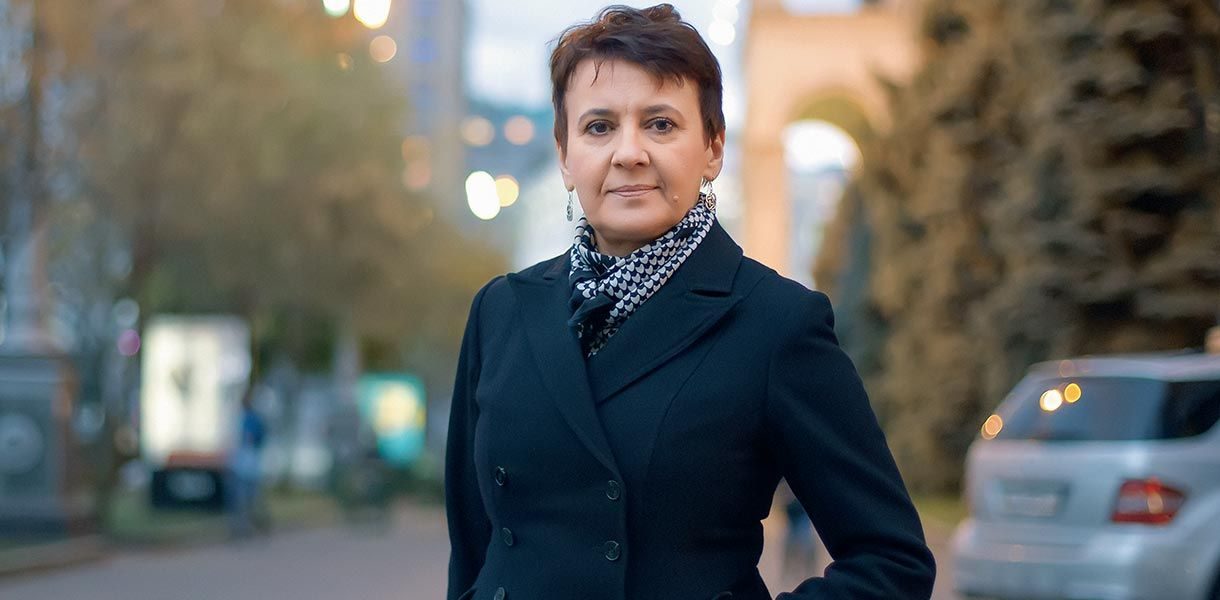
Photo by Dmytro Lypavskyi
Independence is not a one-time action and the war for it is going on till this day. However, another question arises – have we gained independence?
“Well, how could we gain it? We haven’t gained it because we are having the war for independence right now. And not only in the East, not only the direct physical war for the territory. Independence is not an act. Independence is a process.
Maidan was a direct expression of the will of the people with a requirement for the authorities to return to the legal field. This means the crisis of the political system and elites. On the other hand, we see that people as a customer of a state get older, gaining strength. The society is ready to control the authorities.
Back then, in 2014, this curved mirror had crumbled, and for some time arose those not advertised, not required by the media, the best resources of society, the nation. Therefore, I think that by default, this very potential of good is greater in us, that potentially we are better than we think of ourselves than we are accustomed to think of ourselves.
By Dmytro Zhuravel
The publication was collected from numerous interviews, speeches, and appeals of the material’s protagonist.