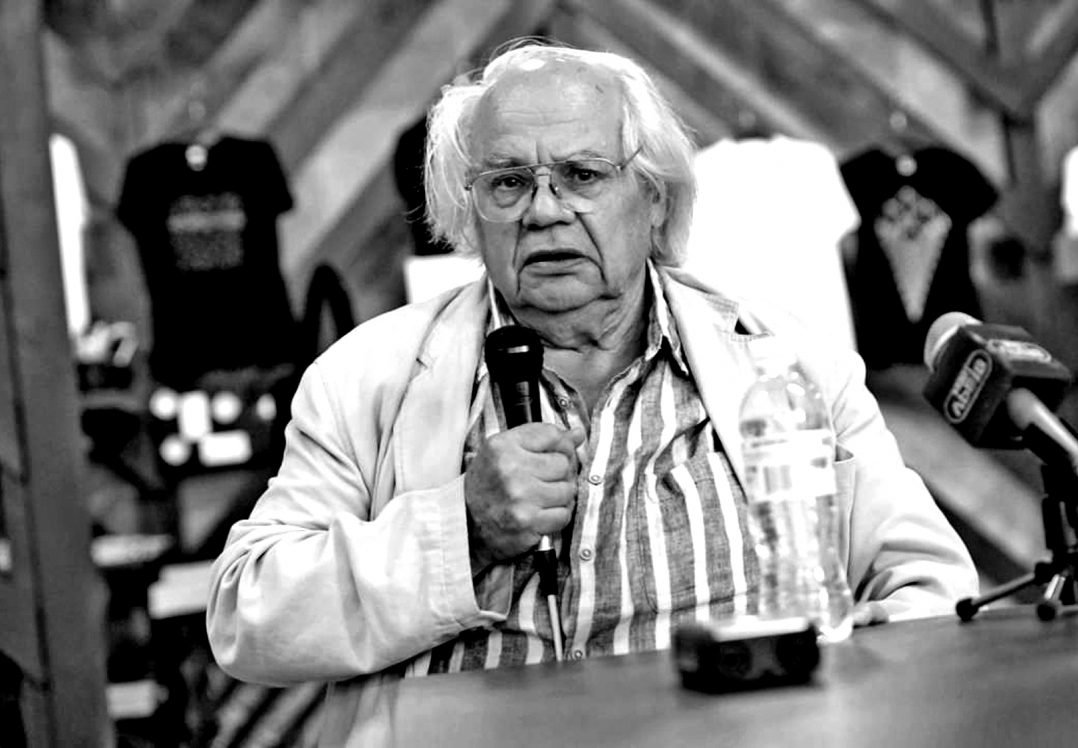


His last interviews clearly show: he knew everything. He knew, indeed. He realized and accepted it. He felt it far more deeply than everybody who had been praising him. Realized more deeply than everybody who had been criticizing him. It is impossible to evaluate the significance of such an ambiguous person as Ivan Drach, especially now, just after his death. We will always remember his activity beginning from the Perestroika and independence times when he became a politician rather than a poet. This fact will always influence our attitude. A politician overshadowed a poet. This shadow is still here. It overshadows everybody who is casting it. Optical illusions. Transition into the other state. In general – it is just hard times. Try to figure it out…
Ivan Drach was born in the village of Telizhnytsi near Kyiv in the family of a collective farm worker… in 1936 – exactly when a Soviet machine of repressions was holding one more grudge against Ukrainians. After finishing a secondary school, he began to work as a teacher of Russian language and literature at local school. He also worked as an instructor at the local Communist society of Youth. “… I was a classical pioneer, a classical komsomolets and was happy when became a candidate for membership in the party. I believed that I finally had an opportunity to change the world. After the 20th Congress of the Communist Party in 1956 (it is known especially for Nikita Khrushchev’s “Secret Speech”, which denounced the personality cult and dictatorship of Joseph Stalin), I truly believed in the war between fair Leninists and evil Stalinists.” Actually, many artists – and not only artists – who lived at those times expressed similar ideas in their diaries. Before judging them, let’s think at first – what could have kept them but for their faith?
In 1955-1958, Drach was serving in the army. Then he was studying at the Kyiv University, but was expelled, as Wikipedia says as well as the poet by himself used to say, for “artistic and politic beliefs”. After that, he prudently went to Moscow, there was more freedom. He entered the High Courses for Scriptwriters, “I was on friendly terms with Paradzhanov and Vingranovskyi (Ukrainian directors), and they were telling me, “Ivan, literature and poetry aren’t a serious business. True art is cinema: it is literature and music, and philosophy, and painting.” They persuaded me, and I went to Moscow for studying. Anyway, I was expelled from the university.”
He started to write poems approximately at that time. Then – strange metamorphoses. Or perhaps, it was a line in the sand. He joined the Communist Party in 1959. In 1961, he continued his studying at the Kyiv University, however as an off-campus student. The same year, during the Krushchev Thaw, he made his debut as a poet. Kyiv’s Literaturna Gazeta published his poem-tragedy “Nizh u sontsi” (“Knife in the sun”). It caused a furor among critics.
What am I for? Where is my flow?
Is it my anxiety, which leads me,
And can’t a Capricorn’s sorrow let go,
And a silver black earth just let be?
In fact, it was the beginning of the most fruitful, meaningful and favorable decade of his life. However, there were also compromises, but bear in mind – optical illusions, hard times and transition. “… when my first book “Soniashnyk” (“Sunflower”) was being edited, I was told that it was lack of any ideological element. Well, no problems, I made up some small poem about Lenin in a minute… I didn’t think then that in future it could be taken differently.”
As the first dissidents were arrested, Drach wrote an open letter where he was repenting for his connections with them. His relationship with authorities improved. A compromise with himself seemed to deepen. However, the decade (from 1961 up to new great repressions in 1972) created a poet Ivan Drach. Made him one of the most prominent poets of the XX century. He opened his world. A modern, tender world, a very complicated world. That world existed within a certain system of contradictions, which was born by development of the civilization. The world of romantic Sixtiers (representatives of а new generation of the Soviet Intelligentsia, most of whom were born between 1925 and 1945, and entered the culture and politics of the USSR during the late 1950s and 1960s — after the Khrushchev Thaw). That world not only praised powerful innovations but also was anxious about Ukrainian national patriarchal world, where Drach had come from, where, perhaps, he wanted to stay. The conflict between the civilization and patriarchal world makes the poet feel a strong mental dissonance, however, this is what makes his world, this is what makes him a poet. Drach feels like he is broken, but actually his artistic career is flourishing.
Then he made some more compromises. Then Drach just mastered more deeply what he had found out earlier. Disappointment, dissatisfaction with himself, sacrifices at the altar of government. Drach criticized in blunt terms a bourgeois nationalism, praised the communist party in his works as well as in speeches. He created poems devoted to Lenin and the party.
In 1966 Ivan Drach was a member of Ukrainian SSR delegation at the UN general assembly in New York. “… they sent some people to Siberia, some – to New York. Pavlychko (famous Ukrainian poet) and I developed a behavior strategy: what and how we should do and say. We were telling there that some people had been arrested (these people were, in particular, the brothers Horyn (politicians), Myhailo Kosiv, an art expert) and that we were hoping that they were not connected with bourgeois nationalism, and they would be free soon. As Ukrainian communists, we supported the position of Skrypnyk, Hvyliovyi, Shumskyi: we don’t need Ukraine without communism, and we don’t need communism without Ukraine.” This is how dialectic of Drach or of the hard times he lived in looks like. Let’s avoid judging, because…
Ivan Drach wrote scripts for three films – without exaggerations three cinema masterpieces, which were to become the classics of Ukrainian poetic cinema. ‘Well for Thirsty” by Yurii Illienko (1965), “Stone Cross” by Leonid Osyka (1968) and “The Lost Letter” by Borys Ivchenko (1972) – these films are so well-known that they don’t need any additional introducing. Though, we can say one more time: a screenwriter is Ivan Drach.
In 1989, Ivan Drach was elected the head of the People’s Movement of Ukraine (Ukrainian centre-right political party). Since that time he seemed to live between literature and politics, but more closely to the latter.
“I’ve achieved too little in my life. I regret spending too much strength, will and energy for politics. It doesn’t t give enough joy. If I had worked more with literature, it would have given me more joy.” One more quote which seems to have been burnt through with a bitter irony. “I feel like I haven’t succeeded as a writer – as a prosaist, play-writer and film director. Well, I can say that I have my whole life ahead in my 76…” Let’s not judge. A person, who has judged him- or herself doesn’t care about others’ judgments.
And the last thing. Ivan Drach once said that if he had met the God, “I would apologize for being who I am.” Now he is there, perhaps, at the high offices where all the achievements and compromises will be counted. They won’t miss anything, for sure. Something will weigh more on the scales. We want to believe that, anyway, it will be a sunflower, which stands on asphalt.
Mykola Vorobiev once wrote about Ivan Drach:
He wasn’t able to fully break the house.
But it is good that children can run through the hole,
which has been there
since his youth.
However, finally, he broke that house.
But all the walls stayed undamaged.
And they all are protecting him from other walls –
They may seem not to exist at all.
(1988)
It is better than any obituaries. Let him be remembered forever.
By Serhii Osoka