

In Russia, where dozens of Ukrainian political prisoners are suffering, Mundial continues. In the first days of the football forum, for boycotting of which the world didn’t turn ripe, the Commissioner of the Verkhovna Rada of Ukraine for Human Rights Lyudmyla Denisova visited the Russian Federation, with the intention, among other things, to meet with our captives. Soon there will be a hundred days as the Ombudswoman took up her post. The time limit is not enough to require a serious result from the Commissioner but it is a high time to indicate the trends and draw intermediate conclusions. After all, the issue of releasing prisoners, who have declared a hunger strike, does not tolerate delay.
A word to the Constitutional Court
The five-year cadenza of Valeriya Lutkovska, the Human Rights Commissioner of the Verkhovna Rada of Ukraine, ended on April 27, 2017. Since the Parliament did not agree on the candidacy for a new ombudswoman, Ms. Lutkovska remained an “overdue” Commissioner for almost a year. Despite her election under the presidency of Yanukovych, mainly by the votes of the regionals, Valeriya Volodymyrivna earned her authority in the sphere, entrusted to her, even her opponents recognized her professional qualities.
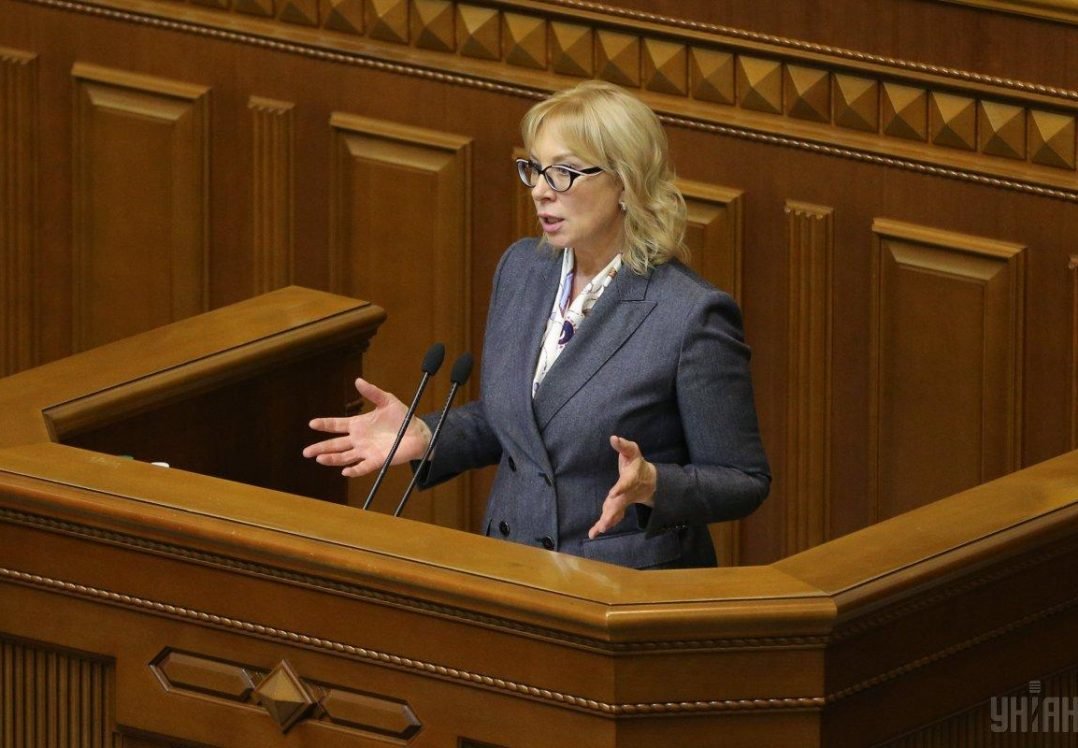
Lyudmyla Denisova replaced Valeriya Lutkovska on March 15, 2018. Once again, the choice of an independent figure of the ombudswoman was not without a political factor. Ms. Denisova from the People’s Front Party is considered to be close to Interior Minister Arsen Avakov. The lack of human rights practice experience is called by opponents of Lyudmila Leontiyivna as one of her main shortcomings.
The election of Ms. Denisova to the post of the Commissioner took place by open voting with violation of the regulations. 45 people’s deputies, dissatisfied with the situation, appealed to the Constitutional Court after more than two months.
“The goal is not to change the Commissioner – we want to restore the legality”, Iryna Suslova, the Chairman of the Subcommittee on Gender Equality and Non-Discrimination of the Verkhovna Rada Committee on Human Rights, National Minorities and Interethnic Relations explained to DUMKA.”During the election of the Ombudsman, they violated a number of Ukrainian laws and international standards. In particular, the Paris Principles of the United Nations, the Law “On the Commissioner of the Verkhovna Rada on Human Rights”, the Rules of Procedure of the Verkhovna Rada. The procedure for electing a Commissioner requires exceptional legal purity. After all, the protection of human rights is the main indicator that will allow us to enter the club of developed European countries”.
Ms. Suslova is convinced that the Constitutional Court will recognize the procedure of electing the current ombudswoman as unconstitutional. And the procedure will be restarted, new candidates will be nominated, an open vote will be held again. According to the people’s deputy, the best ombudsman is not a politician but an experienced authoritative human rights activist.
Dialogue with the office
The work of the Secretariat of the Ombudsman for Human Rights, in addition to the actual protection of rights, also provides for active communication with the society, in particular, human rights defenders, officials, journalists. It can hardly be said that communication is active.
Valeriya Lutkovska, who headed the recently created NGO “Ukrainian Institute for Human Rights”, told: “We did not establish such a dialogue, because we are trying to understand what we will do specifically. If our competences somehow cross, then I think the dialogue will be possible. At least for my part but then everything will depend on the new ombudsman”.
“As a people’s deputy, during the leadership of Lyudmyla Denisova, I sent 7 applications to the Ombudsman’s office, to which I received the answers”, Iryna Suslova said. “Unfortunately, the effectiveness of the dialogue between the Commissioner and the Profile parliamentary committee has significantly decreased. If the former Commissioner regularly attended the committee meetings, had her own principled position and defended it, then Lyudmyla Denisova attended the meeting only once, the other time her representative was present. They did not submit any comments or suggestions. Such format does not allow fruitful results”.
Human rights activist Semen Gluzman assured DUMKA that he had a warm relationship with Valeriya Lutkovska. He refused to characterize the work of the new ombudswoman.
Mykhailo Chaplyga, the representative of the VRU Commissioner representative of human rights (2012-2018), was frank with DUMKA: “I do not see a dialogue with civil society in the new office at all. There is no desire from the office to interact. And this concerns the overwhelming majority of human rights organizations”.
Obviously, journalists also need better communication with the ombudsman’s office. No one has ever picked up the phone of the press service of the Hearing Officer for a few days. We waited a week for an answer to the e-mail at the address [email protected]. In vain. It was necessary to involve Facebook and mobile phone in order to reach one of the representatives of ombudsman Aksana Filipishyna.
Work continues
With the preliminary ombudsman, Ms. Aksana dealt with issues of respect for the children rights, non-discrimination, and gender equality. She was recently appointed to the post of representative of the Ombudswoman for the Rights of the Child and the Family.
“The block against discrimination has passed to the competence of a representative, who has not yet been appointed”, Ms. Filipishyna told DUMKA. “In fact, nothing has changed, I’m not limited in making decisions to respond to cases of both violations of the children rights and discrimination. In addition, I continue to be involved in all processes related to discrimination, for example, the Roma national minority in the context of pogroms that occurred in Ukraine. Many children have suffered”.
According to Ms. Aksana, fruitful work continues in the office, many changes are expected. The position of the new ombudswoman is to interact not only with civil society but also with state bodies.
“Before that, there were expert councils with representatives of the Commissioner, now they have coordinating councils, and not only representatives of civil society were invited to participate but also profile ministries and departments”, explained Aksana Filipishyna. “In my direction, these are the Ministry of Education, the Ministry of Health, the Ministry of Social Policy, the National Police, the Prosecutor’s Office. Several approaches are changing, we will see how effective this will be. The idea is to not just discuss problematic issues with the public but involve representatives of state institutions in order to immediately make a decision, to develop algorithms of actions for the identified problems”.
Cautious criticism
Officials do not show a desire to evaluate the work of a Commissioner. Vladyslav Vlasyuk, the Director of the Department for Human Rights, Access to Justice and Legal Awareness of the Ministry of Justice, refrained from communicating with DUMKA. And Ihor Gryb is in the post of the head of the Department for people deprived of personal freedom, the Ministry for Temporary Occupied Territories just the second week. However, he is a member of the Management of the charity foundation and public organization of relatives of the Kremlin prisoners. His son Pavlo has been imprisoned in Russia for 10 months (Mr. Ihor assured that among the plans of Lyudmyla Denisova during her visit to the Russian Federation is meeting with Pavlo).
“A new team came, to put it mildly, not quite touching to these issues, and on it, referring to the Office of the ombudsman, the issues of internal protection of the rights and freedoms of citizens, and political prisoners and prisoners of war were superimposed”, Ihor Gryb told DUMKA.”For three months we met once as public figures, human rights activists. The meeting was in the Verkhovna Rada with relatives of political prisoners of the Kremlin, prisoners of war and mothers of servicemen, missed in the East of Ukraine. There was the first acquaintance with Denisova and representatives of her office. So, as I understand, they are getting on the course. In their place, I would develop materials, would be aware of all available information to understand what needs to be done. Therefore, it is not entirely correct to evaluate their work now”.
Many human rights activists do not want to rattle pots with Ms. Denisova, their statements are rather cautious. The main argument: 100 days is a short time for conclusions. Before interrogating the new ombudswoman, you should give her a carte blanche for a longer period. According to Oleksandr Pavlichenko, the Chairman of the board of the Ukrainian-Helsinki Human Rights Union, this will take 5-10 months.
“During this time, I, perhaps, went to the office twice”, said to DUMKA Oleksandr. ”We are open for cooperation but there the Commissioner is still joining the system, and I would not give an assessment now. Moreover, a rather large team of Valeriya Lutkovska, the Commissioner of the previous cadenza, left the office. This is another reason for its certain easing. Modifying the teams requires new people to enter the process”.
“A comprehensive analysis of the work of the ombudswoman can be given after a longer period of Lyudmila Denisova’s tenure in this position”, Iryna Suslova said. “As a legacy from Valeriya Lutkovska, she received a well-coordinated system of work of the office, which has an extensive regional representation. Even with the worst-case scenario, this human rights system will for some time work qualitatively at the expense of previous achievements. Actually, the achievements or shortcomings of the work of Lyudmyla Denisova will manifest later. And then we will see whether it will be able to maintain the quality of the ombudsman’s office at the level of recent years, or this structure is rapidly degrading”.
Is the National Preventive Mechanism collapsing?
The fact that this negative process is already going on is evidenced by the characterization of the office of Mykhailo Chaplyga. What is going on, he called “catastrophe”.
“The basis of the National Preventive Mechanism against torture has been blown up”, the human rights activist said. “Probably, this is one of the best and most important achievements of the last 6 years of the previous ombudsman work. It is a question of a system of unannounced visits of public monitors to places of unfreedom and objective informing of the public and authorities about the situation in those places. This is a tragedy, which is spoken at the level of international organizations and embassies”.
Other experts surveyed by DUMKA are less categorical about the destruction of the NPM but the destiny of this mechanism does not leave anyone indifferent. After all, human rights defenders receive alarming signals that the Commissioner does not want to work with the public, that is, to involve independent monitors in the monitoring process.
“I hope this is a temporary misunderstanding and the situation will change”, Iryna Suslova is convinced. “After all, without the public, NPM can turn into a bureaucratic formality. With all respect to Lyudmyla Denisova, many people are concerned about her closeness to former party members, who head the system of the Ministry of Internal Affairs and Justice. We can roll down to the fact that the penitentiary system controls itself, as it was in Soviet and post-Soviet times”.
One of the meetings of Oleksandr Pavlichenko with the new ombudsman concerned exactly the activities of the NPM, which, according to the human rights activist, is currently deprived of the mandate. However, the Ukrainian Helsinki Human Rights Union Chairman hopes that the situation will be resolved positively.
And Valeriya Lutkovska learned about the state of NPM from the monitors on Facebook: “I do not know how the further relations with the office will develop but in order to avoid such an opportunity, if there is no control over human rights in places of lack of freedom, and not only in the penitentiary system but also in the social sphere, we are also considering the creation of a system of alternative independent monitoring. I think we will succeed”.
Mykhailo Chaplyga named another serious lack of activity of the Commissioner – the subversion of the independence of the office itself: “All my life I condemned the Russian ombudsman institution for the fact that the ombudsman there, despite his independence, goes to reports to Putin and receives instructions. Maybe in Russia it looks normal but in terms of sound sense and understanding of the foundations of independence – it is nonsense. Recently they saw a message on the President’s website, where our ombudsman sits, as a schoolgirl, and the President gives her instructions. There is no point in talking about some kind of independence”.
Reference:
The National Preventive Mechanism (NPM) is an independent national body, operating under the Optional Protocol to the UN Convention against torture. It provides for regular monitoring of all places of lack of freedom to prevent ill-treatment of people, who are there.
Denisova in Russia
On the main page of the website of the Commissioner of the Verkhovna Rada on Human Rights, the inscription “Freedom to Political Prisoners! Chronicle of starvation”. And the names of the Ukrainian captives of the Kremlin, declared a strong protest, as well as counting the days of starvation. Obviously, the release of our prisoners is among the priorities of the ombudsman Denisova. And her recent visit to Russia is a confirmation.
“This is the realization of the idea that I started in 2016 when we started negotiations on monitoring visits”, told Valeriya Lutkovska. “One such visit, common with the Russian ombudsman, was carried out. I had the opportunity to visit Ahtem Chiygoz and other Crimean Tatars, who were detained in the Simferopol jail. The same day, Tetyana Moskalkova visited two Ukrainian and Russian citizens in Mykolayiv jail. If this continuation will be successful, it will only benefit the citizens of Ukraine”.
What is the result of the ombudsman’s visit to Russia? Lyudmyla Denisova traveled across Russia but she was never allowed to go to Oleg Sentsov, Mykola Karpyuk, Roman Sushchenko. She was not provided the information about Sentsov health, who has been starving for more than a month. Our ombudsman tried to see Ukrainian prisoners before she met her Russian counterpart, Mrs. Moskalkova. During this meeting, the development of a roadmap for visiting prisoners began.
Even during the first days of Ms. Denisova’s stay in Russia, the opponents called the trip “tourist” and attempts to influence the fate of Ukrainian captives – the usual PR. This, they say, can lead to a loss of balance in the negotiations with the Russians. However, probably, one should also take into account the fact that Ukrainian ombudwosman had a very complicated task – to break the ice of indifference and ignorance on the part of the leadership of the aggressor country.
Text: Viktor Tsvilikhovsky